







Sri Lanka may look small on the map, but traveling here can feel surprisingly complex for first-time visitors. From chaotic roads, the so-called “tuk-tuks”, to the changing weather across the island, there are many little things that can catch travellers off guard.
Understanding a few practical travel tips to Sri Lanka can make you trip in this island more enjoyable. This guide brings together the most important things you should know before visiting Sri Lanka, based on real traveler experiences.
When is the best time to visit Sri Lanka?
Sri Lanka is influenced by two main monsoon systems, which means the best travel season varies between the south-west and the east coast.
| Region of Sri Lanka | Best travel months | Key destinations |
|---|---|---|
| South & West Coast | Late Dec – April | Colombo, Galle, Mirissa, Unawatuna |
| Cultural Triangle & Hill Country | Late Dec – April | Sigiriya, Kandy, Ella, Nuwara Eliya |
| East Coast | May – September | Arugam Bay, Nilaveli, Trincomalee |
| Wildlife Parks | Jan – Apr Feb – Sep |
Yala, Udawalawe Minneriya, Kaudulla |
Note that Sri Lanka’s high booking season is usually December to April since the weather is driest during that period. So if you plan a trip at this time, note that hotels may book out quickly (best to book 2-3 months in advance!) and scenic train journeys like Kandy to Ella should be reserved beforehand.
Getting connected in Sri Lanka: Wi-Fi & SIM cards
Buy a local SIM at the airport
The easiest place to get connected is right after you land at Bandaranaike International Airport. Here, counters are open 24/7 in the arrivals hall and there are a wide range of ready-to-use tourist packages with data and calls that’s typically around 10-30GB.
Here are 3 reliable mobile operators: Dialog (best overall coverage), Mobitel (good in cities), and Airtel (often cheaper).
Note: You must show your passport when purchasing. The process takes 3-5 minutes, and staff handle all registration.
eSIM options
If your phone supports eSIM, you can install one before arriving (e.g., Airalo or Holafly). Choose a local eSIM if you stay longer or need a local number. Choose a travel eSIM if you prioritize simple pre-departure setup for basic data needs.

Mobitel counter at Bandaranaike International Airport
TRAVEL TIPS
Planning your trip to Sri Lanka? Make sure your journey starts smoothly by applying for your visa in advance
Transportation tips that will save time and money
Use Uber and PickMe
PickMe (Sri Lanka’s local app) and Uber are widely used in cities like Colombo, Kandy, and Galle—often cheaper than street tuk-tuks. At Bandaranaike International Airport, there are even designated pick-up points for ride apps.
Tip: Many drivers prefer cash to avoid card payment delays.
Confirm the fare before starting a ride
If you take a tuk-tuk or local taxi outside ride apps, make sure to agree on the price before the ride begins. Some taxis may have meters, but they are not always used, and occasionally there are inaccurate or “creative” meters.

A tuk-tuk in Galle, Sri Lanka
Hire a private driver for multi-day trips in Sri Lanka
For multi-day trips, the biggest advantage of hiring a private driver is time efficiency. Sri Lanka is not a very large country, but travel can still be slow due to mountain roads, traffic, and transfers between trains and buses.
The estimated cost is usually around $80-100 per day, depending on the route and type of vehicle. When booking, make sure to ask what is included in the price, such as fuel, highway tolls, driver accommodation for overnight trips, and how many kilometres or hours are covered each day.
Plan extra time than your map suggests
Travel in Sri Lanka is often slower than what Google Maps predicts. In reality, many roads are narrow, traffic can build up near large cities, and mountain routes in the hill country also add extra time.
Traffic can be heavy in urban areas during certain times of the day. If possible, try to avoid traveling during:
- 7:00–9:00 AM (morning commute and school traffic)
- 1:00–2:00 PM (school dismissal)
- 4:00–6:00 PM (evening rush hour)
EDITOR’S PICK
Save yourself the transport hassle! Experience the best of the island seamlessly with our top-rated Sri Lanka itineraries.
Money tips & payment reality in Sri Lanka
While Sri Lanka is modernizing, payment habits lean heavily toward cash, especially outside major tourist zones. The local currency is Sri Lankan Rupee (LKR).
You will heavily rely on cash for: Tuk-tuks, local transport, small restaurants, street food vendors, local markets, and entrance tickets at smaller attractions.
- Extra card fees: Check for extra fees when paying by card at smaller restaurants or independent businesses. These fees help them cover bank transaction costs.
- ATMs: Use machines inside banks or shopping malls for better security and favorable exchange rates.
- Tipping: Common but not mandatory. Leaving around 5-10% for good service is highly appreciated.
Sri Lankan cultural etiquette travellers should know
Sri Lanka’s culture is deeply shaped by Buddhist traditions, Hindu heritage, and centuries of multicultural influence, with around 70% of the population following Buddhism. Because of this, visitors are expected to follow a few basic etiquette rules that reflect local values of respect, modesty, and mindfulness.
Respect Buddhist temples and sacred sites
Many historic attractions, such as Dambulla Cave Temple or the Temple of the Tooth, are not just tourist sites but active places to worship. So before visiting temples, here are practice etiquette tips that can be useful:
- Remove shoes and hats before entering temple buildings.
- Wear clothing that covers shoulders and knees. Consider carrying a light scarf or sarong to cover shoulders.
- Walk clockwise around stupas or shrines, which follows Buddhist tradition.
- Never take photos with your back turned to a Buddha statue. People consider this disrespectful!
Use the right hand when giving, receiving or eating
Sri Lankan etiquette is influenced by South Asian cultural norms, where the right hand is traditionally used for social interactions and meals. Meanwhile, the left hand is historically associated with personal hygiene, which is why many locals avoid using it in public exchanges.

Dumballa Buddha Cave

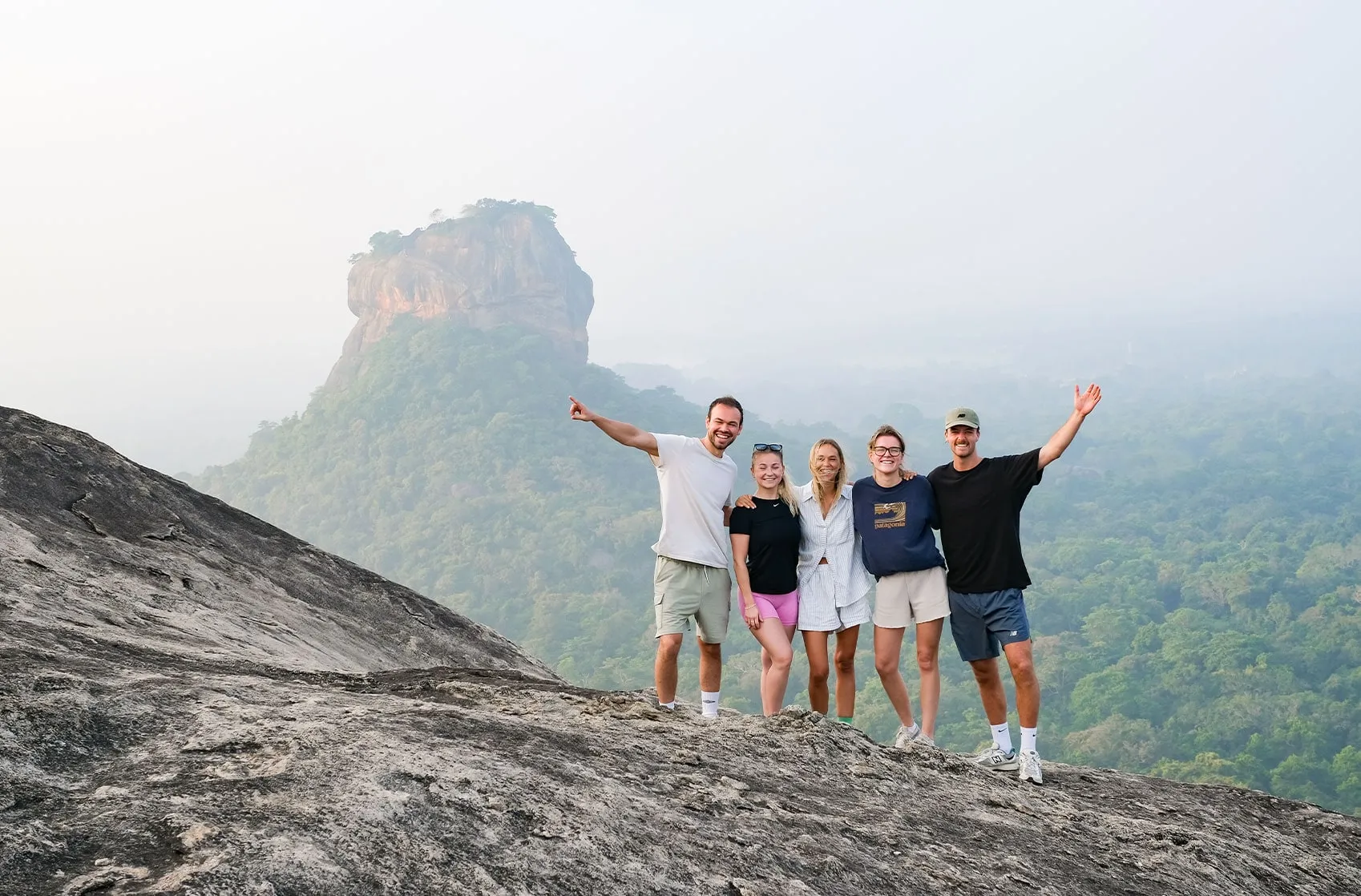
TSA’s Vietnam Team at Sri Lanka
Learn simple greetings in Sinhala
Sri Lanka has three commonly spoken languages: Sinhala, Tamil, and English, and making even a small effort to greet someone in the local language often creates an instant connection.
A traditional greeting such as “Ayubowan” – a Sinhala phrase meaning “may you live long” – or “Vanakkam” (“I bow to you” in Tamil) is widely appreciated.
Poya Days may affect your travel habits
One very practical cultural norm many people miss is the importance of Poya days, the full-moon Buddhist holidays observed monthly. On these days, devotees visit temples, and alcohol sales are generally prohibited.
So if your trip includes beach towns or hotel bars, check the calendar in advance rather than assuming every evening works the same way.
Understanding food culture in Sri Lanka
Sri Lankan food culture is much bigger than “spicy curry.” Influenced by South Indian, Arab, Dutch, and Portuguese trade routes, the food culture here is built around bold spices, coconut-based dishes and a communal style of eating that may feel different from what many travelers are used to.
Rice and curry is the foundation
A practical way to understand is this: Sri Lankan food is not usually built around one main dish with a few sides. It is often built around a center of rice or a starch and then a set of curries, sambols, pickles, and condiments that are meant to work together in one meal.

A cooking class and mini buffet in Hiriwadunna
Breakfast is taken seriously
Sri Lankan breakfast is one of the best windows into local food culture. Instead of toast-and-coffee habits, locals love freshly made savoury food for their first meal of the day:
- Hoppers (bowl-shaped rice pancakes),
- String hoppers (thin rice noodle mats), and
- Roti with coconut sambol.
Tea is life
Sri Lanka is globally famous for Ceylon tea, and tea drinking plays an important role in daily life. Tea is typically served with milk and sugar in small cups as a gesture of hospitality, no matter if you are in a hotel, in a restaurant or a local residence.
Visitors exploring the central highlands around Nuwara Eliya or Ella can often see tea plantations where leaves are harvested and processed.
WILDLIFE DISCOVERY
Do you know? A safari in Sri Lanka suits almost every travel style, from families and first-timers to travellers who simply want a comfortable, low-effort way to experience the wild.
Is Sri Lanka safe for tourists?
Sri Lanka is widely considered one of the safer travel destinations in South Asia. However, keep these things in mind:
Road safety & Wildlife
One of the main safety concerns for visitors is road safety. Road culture in Sri Lanka can be chaotic, like the frequency of aggressive-driving buses, the tuk-tuks weaving through traffic or sometimes, animals wandering onto roads or towns.
For wildlife encounters, tourists should remember:
- Never feed wild animals
- Keep distance from elephants
- Avoid interacting with monkeys
Tropical heat limits
Cities like Colombo and Galle often reach 30–35°C (86–95°F) with high humidity. Make sure you stay hydrated (bottled water only!), take breaks when doing outdoor adventures, and use mosquito repellent constantly.
Ready to experience Sri Lanka?
Now that you know the key things to know before visiting Sri Lanka, the next step is turning that knowledge into a well-planned journey. Understanding local customs, safety tips, and travel logistics can make a huge difference, and that’s exactly where Travel Sense Asia can help.
-Curated itineraries covering Sri Lanka’s top highlights.
– Flexible trip durations ranging from 7-day getaways to 3-week journeys.
– Specialized styles: adventure, wildlife safaris, cultural tours, and honeymoon escapes.
– Trust our local expertise with 15-year of industry experience!
Frequently Asked Questions (Q&A) about Travel Tips to Sri Lanka
Do I need a visa to travel to Sri Lanka?
Yes, most travelers require a visa. The most convenient way is to apply online for an Electronic Travel Authorization (ETA) prior to your arrival. It is typically valid for 30 days. Also, ensure your passport has at least 6 months of validity remaining from your date of entry.
What plug adapter will I need in Sri Lanka?
Sri Lanka commonly uses three plug types: Type D (three round pins), Type M, and Type G (standard UK three rectangular pins). Because outlets can vary even within the same hotel room, bringing a universal travel adapter with surge protection is highly recommended.
Is English widely spoken in Sri Lanka?
Absolutely! English is widely spoken and understood, especially in tourist hubs, hotels, and restaurants. Communicating, asking for directions, or ordering food is generally effortless for English speakers. Though, throwing in a Sinhala greeting like “Ayubowan” will easily win locals’ hearts.
Can I use US Dollars or Euros in Sri Lanka instead of local currency?
While some large-scale hotels or upscale tour operators might accept USD or Euros, everyday transactions (tuk-tuks, street food, local shops, and small ticket counters) strictly require the Sri Lankan Rupee (LKR). It is best to stick to LKR by withdrawing from local ATMs or exchanging a small amount at the airport upon arrival.
What essential items should I pack for a trip to Sri Lanka?
Since the weather is tropical, pack lightweight and breathable cotton clothing. However, if you plan to visit the higher altitude Hill Country (Nuwara Eliya, Ella), bring a light jacket or fleece, as temperatures can drop significantly at night. Lastly, don’t forget mosquito repellent and slip-on sandals (since you’ll frequently remove them at temples).