








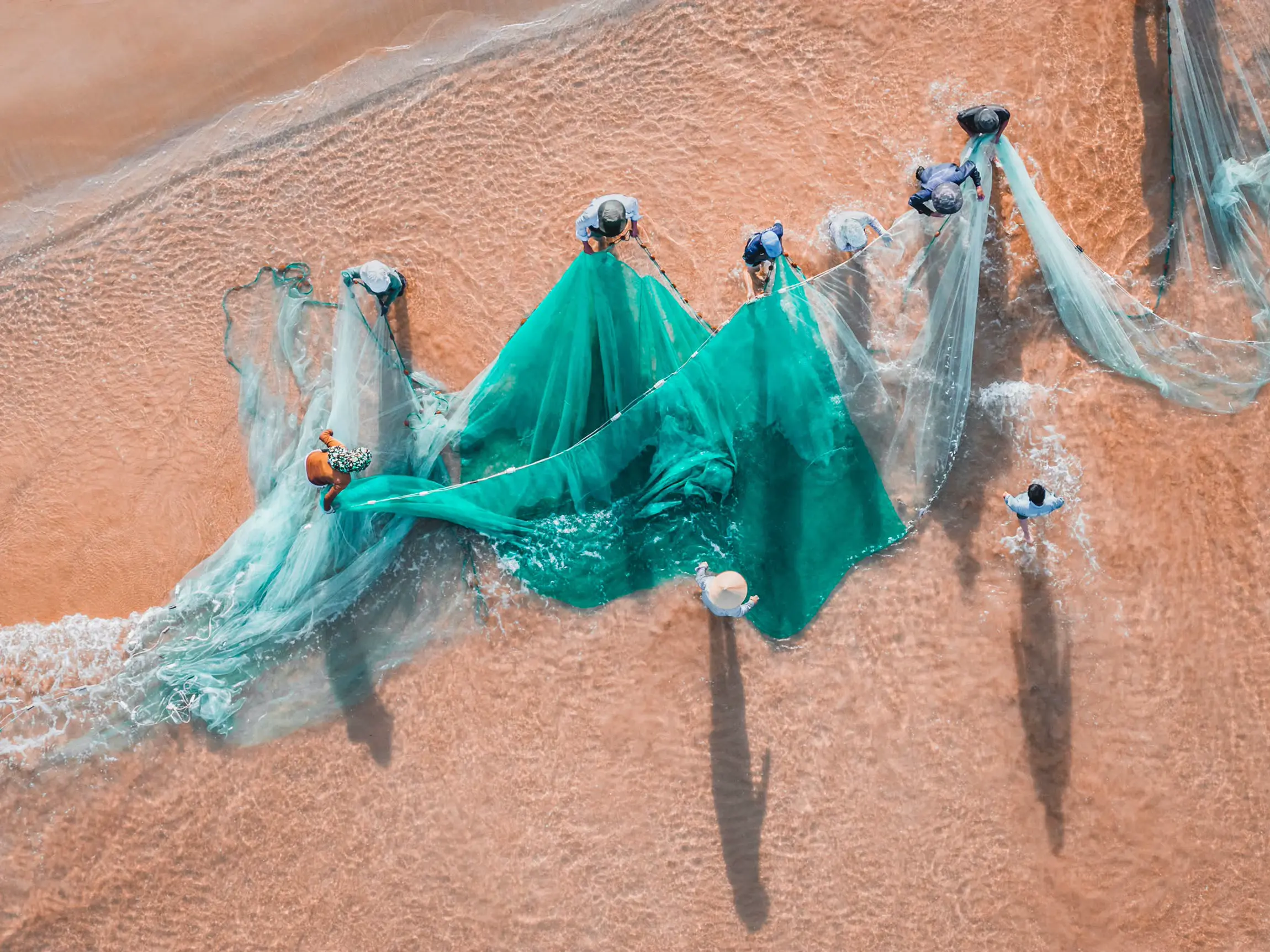
If you plan to travel to vietnam, you will find that it is a dream destination for photographers, but some of its most captivating scenes are found far beyond the country’s famous cities. Scattered along dramatic coastlines and traditional fishing village communities are settlements where everyday life and breathtaking natural landscapes come together.
This guide highlights seven of the most enchanting seaside villages in Vietnam for photography, with practical tips on the best seasons, ideal shooting times, must-visit viewpoints, and the photography styles that work best at each location.
Tuyet Diem Salt Making Village, Dak Lak
Tuyet Diem sits beside Cu Mong Lagoon, where seawater is channelled into broad, shallow pans beneath Cu Mong Pass. The village is now part of Xuan Canh Commune in Dak Lak Province, although older maps and travel guides may still list it under Song Cau, Phu Yen.
A special part of Tuyet Diem is its “hầm muối” tradition (translation: “salt caves”). Despite the name, these are not technically underground salt caves; they are kilns where raw salt is placed in clay pots and heated overnight to produce finer, drier salt. Salt has been made here since at least the 18th century. The flat pans form a grid across the landscape, while still water reflects the surrounding hills, passing clouds and people working between the fields.

Tuyet Diem, Dak Lak
| Aspect | Details |
|---|---|
| Best season | March to August is generally the safer period for dry weather and active salt production. Harvesting depends on several sunny days, so activity may pause after rain. |
| Best time | Visit around sunrise for reflections and softer light. Late afternoon can be better for warm colours and photos of salt being collected. |
| Crowd level | Generally low. Tuyet Diem remains a working village rather than a busy sightseeing attraction. |

An Hai & Hon Yen Fishing Villages, Dak Lak

Hon Yen, Dak Lak
An Hai and Hon Yen Fishing Villages sit along the eastern coast of Dak Lak, in the area formerly known as Phu Yen. Hon Yen Village is around 20 kilometres north of Tuy Hoa, while An Hai just lies 10 kilometres farther. The two locations offer very different photography experiences. An Hai is shaped by its fishing harbour, sandy shore and early-morning fish market, while Hon Yen is known for its rocky islets and large fishing nets used during anchovy season.
Photographers can capture documentary images at the fish market, portraits of fishing families and wide coastal scenes. Hon Yen is particularly suited to elevated or aerial photography, although drone use must follow current Vietnamese aviation rules and local restrictions.
| Aspect | Details |
|---|---|
| Best season | March to August usually brings drier conditions and calmer coastal weather. The most widely reported period for anchovy-net photography is from May to August, but fishing activity depends on sea conditions and the movement of the fish. |
| Best time | Arrive at An Hai between 5:00 and 7:30 a.m. for the fish market. Visit Hon Yen around sunrise for fishing activity or late afternoon for softer coastal light. |
| Crowd level | An Hai is usually quiet outside market hours. Hon Yen may be busier on weekends and when low tide exposes the coastal reef. |

DISCOVER PHU YEN
Learn more about the hidden gems, volcanic cliffs, and authentic lifestyle in this breathtaking coastal province.
Lo Village, Dak Lak
Lo Village or Làng Lò stretches for around two kilometres along the coast of Hoa Hiep in Dak Lak Province (formerly Phu Yen). The sea has shaped both the village’s appearance and its history. Rows of low houses sit close together behind the beach, with thick walls, wide verandas and sloping roofs built to handle strong sun, salty air and coastal winds. Many houses were built during the 1960s and still have red clay tiles, faded yellow walls and traditional two-room or three-room layouts. From a higher position, the roofs form a patchwork of red and brown between palm trees, narrow lanes and the blue sea.
This village is the best fit for architecture, street photography and environmental portraits. Sunrise gives the roofs and walls softer light, while late afternoon is better for photoshoots taking the theme of village life and people returning along the shore.

Lo Village, Dak Lak
| Aspect | Details |
|---|---|
| Best season | The drier months are more suitable for walking and photographing the village. Festival visits must be planned separately because the dates follow the lunar calendar and can change each year. |
| Best time | Visit between sunrise and 8:00 a.m. for quiet streets and gentle light. Late afternoon is suitable for beach scenes and fishing activity. |
| Crowd level | Usually low on ordinary weekdays. |
| Local activities | The Cau Ngu Festival offers the village’s most active photography scenes. Ceremonies taking place at Lang Ong Lo include whale-worship rituals, boat processions, performances and community events, creating a colourful scenery that works well for photography. |

Hon Khoi Salt Fields, Khanh Hoa

Hon Khoi, Khanh Hoa
Hon Khoi lies in the coastal Ninh Hoa area of Khanh Hoa, close to Doc Let Beach and around 40 kilometres north of Nha Trang. As one of the largest salt production sites in Central Vietnam, this location offers a mesmerizing, mirror-like landscape that stretches as far as the eye can see.
The fields are most active before the heat becomes too strong. Salt production here is still largely completed by hand, primarily by local women wearing traditional conical hats, face masks, and rubber boots to protect themselves from the intense sun and highly saline environment. They expertly rake heavy salt crystals into small, glowing white pyramids and carry them across the shallow pans in woven bamboo baskets balanced on their shoulders (quang ganh).
For photographers, this intense manual labor creates incredibly strong scenes for both wide landscape photographs and intimate, gritty environmental portraits.
| Aspect | Details |
|---|---|
| Best season | The main salt-making season generally runs from March to September. March and April are often safer choices for photographers seeking active harvesting with a lower risk of seasonal rain, but production still depends on several dry days. |
| Best time | Arrive before sunrise, ideally between 4:30 and 6:30 a.m. Workers often begin early to avoid the strongest heat, and the shallow pans can create clear reflections at this time. |
| Crowd level & Access | Usually low on weekdays. More photographers may arrive during the dry season and around sunrise. |

LESSER KNOWN BEACHES IN VIETNAM
Venture beyond the crowds and discover the most secluded and breathtaking coastlines across Vietnam.
Tra Nhieu Fishing-Net Village, Hoi An – Da Nang
Located just a short distance from Hoi An Ancient Town, Tra Nhieu village feels like a step back in time, surrounded by dense water coconut palm forests and peaceful river channels. The most striking photographs in Tra Nhieu often come from the massive, colorful fishing nets. Local artisans spread huge blue and green nets across spacious courtyards to weave, repair, and prepare them for the next ocean journey.
For photographers, the hanging nets act as natural filters, allowing soft, patterned light to fall on the workers. This environment is absolutely perfect for close-up portraits and “hands-at-work” details. Beyond the intricate net-making, Tra Nhieu provides excellent scenes for documentary and wide landscape photography. Photographers can capture wide, scenic shots of local fishermen casting their nets or paddling silently through the nipa palm forests.

Tra Nhieu, Hoi An – Da Nang
| Aspect | Details |
|---|---|
| Best season | February to August usually offers sunnier weather and calmer conditions for cycling, walking and boating. Heavy rain and flooding can affect access during the later months of the year. |
| Best time | Visit between 7:00 and 10:00 a.m. for net-repairing and fishing activity. Late afternoon is better for warm river light, boats and wider landscape photographs. |
| Crowd level & Access | Usually low on weekdays. Small tour groups may visit in the morning for basket-boat trips and craft experiences. The village is around five kilometres southeast of Hoi An Ancient Town and can be reached by bicycle, car or boat. |

EXPERIENCE HOI AN AT YOUR OWN PACE
Embark on a classic Vietnam journey that includes a perfectly balanced free day in the enchanting lantern town of Hoi An.
Nam O Fishing Village, Da Nang

Nam O, Da Nang
Nam O Fishing Village sits where the Cu De River meets Da Nang Bay, close to the foot of Hai Van Pass, which is around 15 kilometres northwest of the city centre. The village is shaped by three connected landscapes: the river mouth, the sheltered bay and the rocky Nam O Reef. Narrow lanes lead towards the shore, where basket boats, fishing nets and small wooden vessels remain part of everyday life.
Nam O is also one of Da Nang’s best-known traditional fish-sauce villages. The craft was added to Vietnam’s National Intangible Cultural Heritage List in 2019, while Nam O fish sauce received geographical indication protection in 2024. The atmosphere is busiest in the morning, when fishermen return, boats move close to shore and production work begins inside family workshops.
| Aspect | Details |
|---|---|
| Best season | February to August generally provides better weather for exploring the village. For green moss and seaweed-gathering scenes, visit from around Tet holiday (late January – early February) until before summer. |
| Best time | Visit the fishing village between 7:00 and 10:00 a.m. For Nam O Reef, arrive before sunrise and check the daily tide schedule, as the moss-covered rocks are clearest when the tide is low. |
| Crowd level | The village lanes are usually calmer than central Da Nang attractions. Nam O Reef can become busy during the moss season, particularly around sunrise and during holiday periods. |

Tam Giang Lagoon, Hue
Ngu My Thanh is the most iconic fishing village in Tam Giang Lagoon. Located about 15 kilometers from central Hue, this village offers a deeply authentic look into traditional Vietnamese river life. Tam Giang is actually the largest brackish water lagoon system in Southeast Asia. The village faces a massive stretch of water where small wooden boats, bamboo fish traps, and local aquaculture farms shape the beautiful view.
The flat lagoon usually stays completely calm around dawn. This creates a giant natural mirror, offering perfect reflections of boats and fishing nets on the water surface. The true highlight of Ngu My Thanh is its early morning floating market. Fishermen return from a long night on the lagoon to sell fresh shrimp, crabs, and fish. They trade directly from their small wooden sampans in the middle of the water.

Tam Giang, Hue
| Aspect | Details |
|---|---|
| Best season | February to July generally offers more reliable conditions for sunrise photography. Rain becomes more common from August, while the later months can bring heavy weather and flooding in Hue. |
| Best time | Arrive around 4:30 a.m., or at least 30 minutes before sunrise. The floating seafood market normally runs from 4:00 to 7:00 a.m. |
| Crowd level | The market period is the busiest time, although it remains a working local market rather than a large tourist attraction. The village is much quieter after 7:00 a.m. |

TRUSTED BY THE VIETNAM NATIONAL AUTHORITY OF TOURISM
Travel Sense Asia is incredibly proud to be recognized on the official Vietnam Tourism board as a premium travel partner.
How to photograph traditional Vietnamese villages responsibly
Photographing traditional Vietnamese villages responsibly means balancing your creative goals with respect for the people who live there. Many villages are active communities rather than tourist attractions, so your behavior can have as much impact as your photos.
Before visiting
- Check the context: Determine whether the village is an active tourism site or a residential community.
- Look for festivals or ceremonies: Traditional festivals, ancestor commemorations and religious ceremonies may affect where visitors can go and whether photography is allowed.
- Verify photography restrictions: Some attractions restrict photography inside communal houses, temples, museums or exhibitions, while others may require permission for commercial photography.
At the village
- Ask before photographing people: For elderly residents weaving mats, making rice paper or practising traditional crafts, a smile, a gesture towards your camera or a simple “May I take a photo?” is usually appreciated. Children should only be photographed with permission from a parent or guardian.
- Watch for restricted areas: Pay attention to signs indicating No Photography or No Drone zones. Respect private ancestral houses, family courtyards and residential areas that are not open to visitors, even if doors are open.
Cultural etiquette
- Dress appropriately at religious and cultural sites.
- During festivals or ceremonies, keep your voice low, avoid stepping in front of processions and follow the directions of organisers or community elders.
- Avoid staging photographs: Do not move baskets, tools, fishing equipment, offerings or craft materials to improve your composition. Likewise, avoid asking someone to repeat an activity simply because you missed the first shot.
Discover the best of Vietnam with Travel Sense Asia
If you’re looking to discover Vietnam through your camera on a vietnam photography tour while enjoying a seamless journey, Travel Sense Asia can help you design a tailor-made itinerary that matches your photography interests.
With over 15 years of experience crafting personalized journeys across Vietnam, Travel Sense Asia helps travellers go beyond the typical tourist itinerary. From arranging transport between remote villages to recommending the best seasons and local experiences, our travel specialists help you make the most of every stop. Ready to plan your photography journey through Vietnam?
FAQ
Where can I photograph salt fields in Vietnam?
Vietnam’s traditional salt fields create some of the country’s most striking photographic landscapes, especially during harvest season when workers collect salt by hand. Recommended locations include:
- Tuyet Diem Salt Making Village (Dak Lak): A traditional coastal salt-making village where photographers can capture local workers harvesting salt, geometric evaporation ponds, and beautiful sunrise reflections.
- Hon Khoi Salt Fields (Khanh Hoa): One of Vietnam’s most famous salt fields, offering dramatic patterns, reflective pools, and iconic scenes of salt farmers carrying baskets across shimmering white fields.
- Sa Huynh Salt Fields (Quang Ngai): One of Vietnam’s oldest salt-producing regions, known for expansive salt ponds and traditional harvesting methods.
The best time to photograph salt fields is during the dry season (typically December through August), with sunrise and late afternoon providing the most beautiful light and reflections.
Can photographers use drones in Vietnam’s fishing villages?
If you’re photographing Vietnam’s fishing villages with a drone, you should consider three separate issues:
- Drone regulations: Vietnam has tightened its drone rules. Current law generally exempts recreational drones under 250 g from needing a flight permit only if they are flown within visual line of sight and outside prohibited or restricted airspace. However, the law also includes drone registration requirements, and larger drones or commercial operations may require additional approvals. The rules have changed recently, so it’s worth checking the latest requirements before traveling.
- Restricted areas: Many coastal areas may be near ports, border zones, military facilities, or other sensitive infrastructure where drone flights are restricted or prohibited. Flying near harbors or naval installations can lead to enforcement action, even if you’re only taking photos.
- Privacy and local custom: Fishing villages are working communities rather than tourist attractions. It’s good practice to ask permission before flying over people, boats, or private property. Some fishermen may object to drones because they can be distracting or raise privacy concerns.
What are the best villages to photograph during the Fall season in Vietnam?
Fall (September to November) brings cooler temperatures, softer light, and vibrant seasonal scenery, making it one of the best times to explore Vietnam with a camera. Highly recommended spots include:
- Tam Giang Lagoon (Hue)
- Nam O Fishing Village (Da Nang)
- Tra Nhieu Fishing-Net Village (Hoi An)
- An Hai and Hon Yen Fishing Villages (Dak Lak)
For the best results, plan your photography sessions around sunrise and the golden hour before sunset, when Vietnam’s villages are bathed in soft, warm light that enhances landscapes, portraits, and cultural scenes alike.