









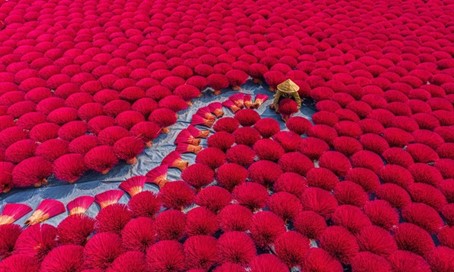
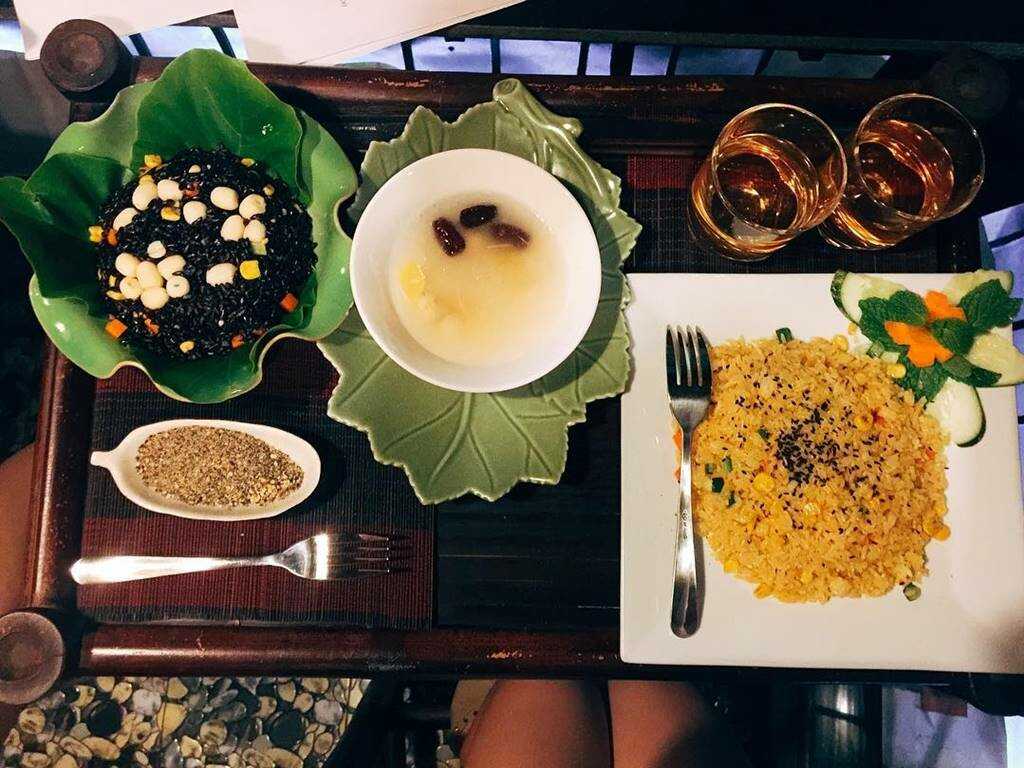
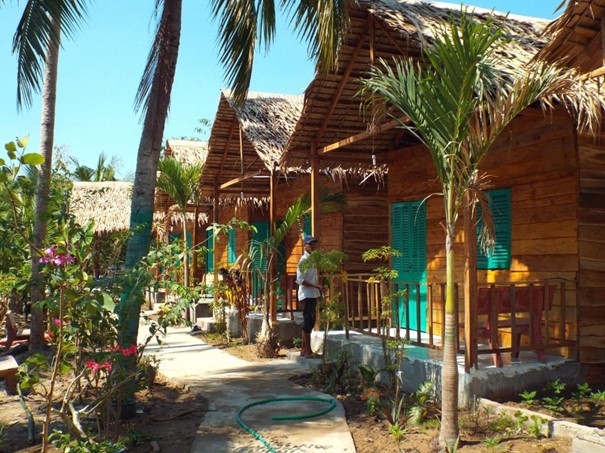
The Ha Giang Loop has quickly become one of Southeast Asia’s most iconic road adventures, drawing thousands of riders each year to tackle its sheer limestone passes and deep river valleys. Yet, because the vast majority of travelers rush through the classic route in a rapid three-day sprint, the journey can easily turn into a blur of crowded roadside viewpoints.
There’s more to explore. Ha Giang is home to 19 distinct ethnolinguistic groups, making it a vital sanctuary for preserving the heritage of almost every highland ethnic minority in Vietnam. This guide is designed to help you slow down and explore four highly authentic, lesser-known ethnic villages: Ma Le, Du Gia, Nam Dam, and Lao Xa.
Ma Le Village
If you are looking to escape the crowded stretches of the standard Ha Giang Loop, Ma Le commune can be an ideal, slow-paced detour.
Where is Ma Le, Ha Giang?
Ma Le spans 42.47 square kilometers in the northern tier of Dong Van District. This quiet karst valley sits roughly 12 to 15 kilometers north of Dong Van town center – right along the road leading up to the Lung Cu National Flagpole.
Because most travelers rush straight to the flagpole without stopping, Ma Le remains beautifully insulated from heavy commercial traffic. To reach the ancient village, you must leave the main paved highway and descend via narrow, unlit concrete pathways. Take extra caution on these tight village lanes.

The backstory of Ma Le
The name “Ma Le” is a living linguistic relic. It is a phonological drift from the indigenous Lo Lo word “Mia” – the original name for this high territory when it was occupied by the Lo Lo people centuries ago. When the Giay ethnic group migrated into the valley, they adapted the pronunciation, slowly shifting it into “Ma Le”. Today, the central ancient village consists of a tight-knit community of over 50 households, populated almost exclusively by the Giay minority.
While the local Hmong populations historically established their swidden homesteads on the sheer, barren limestone slopes of the Geopark, the Giay chose the flatter, alluvial valley floor of Ma Le. This geographic niche allowed them to secure a steady water supply and practice wet-rice agriculture, creating a distinct agricultural contrast to the dry-land corn farming on the rocky peaks above.

The home details at Ma Le’s village
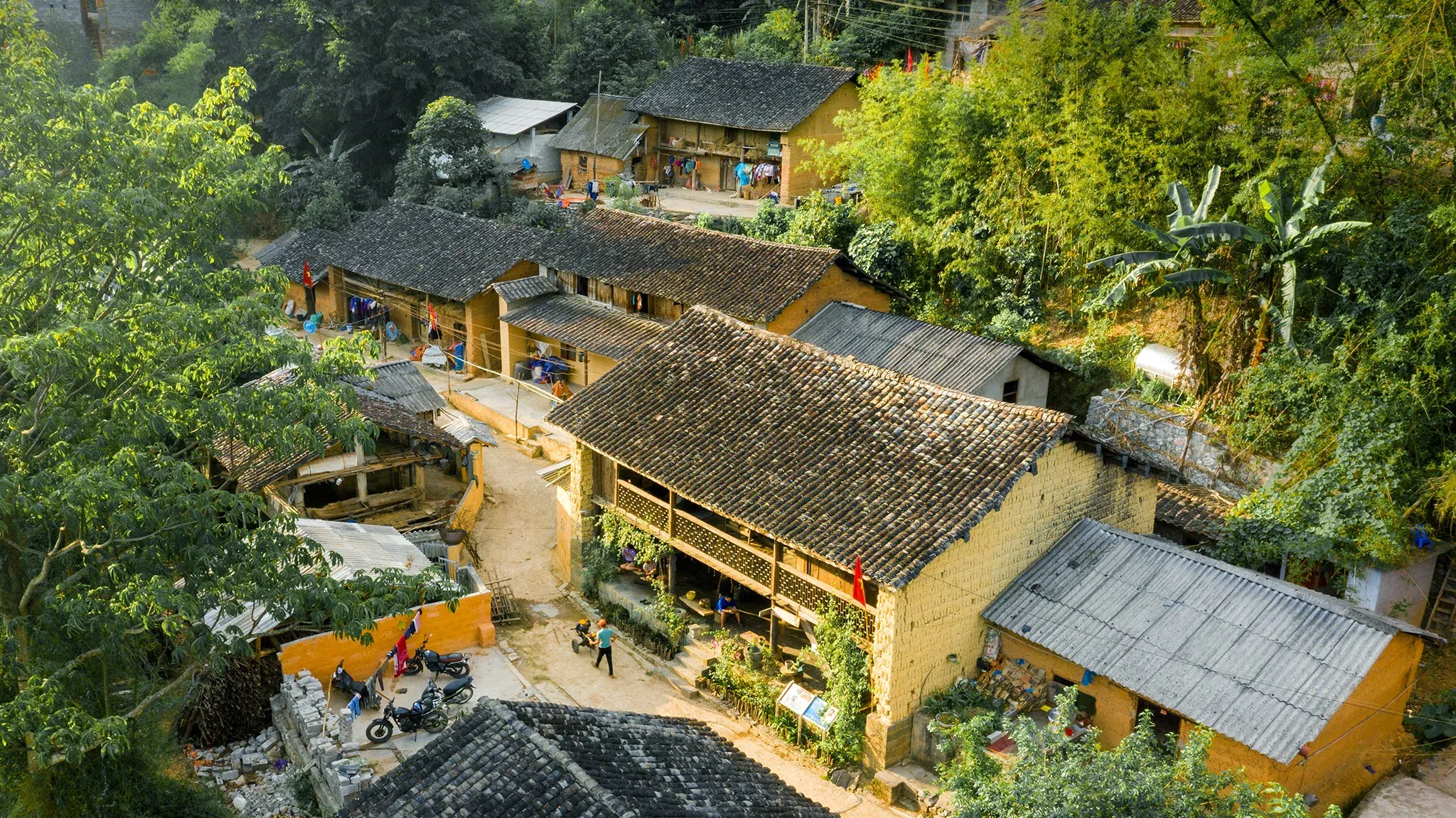
Walk past the buffalo stalls and ricks of drying straw at the village entrance, and you are immediately confronted by an architectural landscape that feels untouched by the 21st century. Ma Le is defined by remarkably preserved, two-story rammed-earth houses (called “nha trinh tuong”). Several of these structures have withstood the harsh montane elements for well over 100 to 200 years. The architecture is a unique hybrid; it retains the classic three-bay interior layout of traditional Giay homes while adopting Hmong-style weatherproofing techniques to survive the freezing high-altitude winters. The engineering behind these homes is brilliant in its rustic durability:
| Architectural Feature | Purpose & Design |
|---|---|
| Mountain alignment (Tua Son) | To block bitter northern winter winds and ensure physical stability, homes are strictly oriented to lean back against a mountain slope. |
| Blue limestone foundations (Da Xanh) | The Giay hand-cut local blue limestone for the foundations and lower wall footings, keeping rising ground moisture from rotting the timber. |
| Rammed earth walls (Dat Nen) | Ground-floor walls consist of thick compacted earth, creating high thermal mass that keeps the interior cool in summer and traps heat during the winter freeze. |
| Yin-Yang roof tiles (Ngoi Am Duong) | Roofs are clad in double-layered, fired-clay tiles that naturally shed rainwater and resist mountain windstorms. |
| Intricate wood & stone carvings | Rafters and column capitals feature carvings of dragon heads, bats, and elephants reflecting local mountain life. |

Things to do at Ma Le Village
The economy of Ma Le remains completely agricultural, operating largely on its own rhythms. The community runs on a dual-farming system: wet rice on the valley terraces and hardy dry-land crops like corn, Job’s tears, and legumes on the steep rocky slopes. Families also produce handmade roof tiles, practice blacksmithing, and distill traditional corn wine.
To truly understand the social fabric of the valley, you must time your trip to coincide with the Ma Le market:
- The 6-Day Cycle: The Ma Le market is a “backward” market. It meets every six days instead of seven, meaning the market day shifts backward by one day each week.
- Traditional dress: Giay women arrive wearing their traditional hand-sewn garments – long black tunics, blue trousers, and fabric shoes embroidered with lovebirds and peach blossoms, symbolizing marital harmony.
- Try the highland cuisine: The food stalls serve hot bowls of thang co (a horse or goat meat stew cooked over woodsmoke) paired with local corn wine.

HA GIANG ETHNIC MARKETS
Dive into the vibrant colors and authentic trading culture at the spectacular highland backward markets.
Du Gia Village
Where is Du Gia, Ha Giang?
Located roughly 70 kilometers northeast of Ha Giang city, Du Gia sits within a lush basin in Yen Minh District. Travelers typically approach it via the DT176 road from Mau Due. Caution: This route is notoriously challenging. Long stretches are unpaved, heavily rutted, and covered in loose gravel. Manual motorbikes with good suspension or 4WD jeeps are essential.
The “hydrology” backstory of Du Gia Village
Unlike the dry highland communes, Du Gia sits within the boundary of the Du Gia National Park (established in 2015). The park spans 15,006.3 hectares across three districts, with 14,068 hectares – over 93% of the park’s entire footprint – lying directly within Du Gia commune. This designated conservation zone protects primary semideciduous forests and provides a critical habitat for the endangered Tonkin snub-nosed monkey.

Things to do in Du Gia Village
While many travelers treat Du Gia as a mere overnight sleeping spot to drink corn wine, this deep valley holds some of the most ecologically and culturally rich experiences in Ha Giang. To help you move past the surface-level backpacker hubs, here is an authoritative, highly practical guide to the best things to do in Du Gia.

- Plunge into the turquoise pools of Du Gia and Tham Luong waterfalls.
- Witness the Geological Grandeur of the Na Lien Canyon (perfect if you already found the famous Tu San Canyon on the Nho Que River spectacular).
- Immerse in a weekly agricultural market: Look for local wild honey, mint honey, black cardamom harvested from the deep forests of the national park, and high-quality Lung Phin tea.
- Visit Phong Luu love market: Held annually from Friday night to Saturday night during the second week of the third lunar month, this event serves as a yearly rendezvous where former lovers can meet, drink, and share stories of their past lives without marital jealousy or social judgment.

HOANG SU PHI BEYOND TREKKING
Explore the hidden cultural gems and authentic experiences of Hoang Su Phi beyond the standard trails.
Nam Dam Village
Where is Nam Dam Village?
Situated in Quan Ba District, about 45 kilometers north of Ha Giang city and just 8 kilometers past the famous Heaven Gate. The access road branching off Highway 4C is fully paved and smooth, making it easily navigable for standard scooters, private cars, or even bicycles.
How local life is like in Nam Dam
Nam Dam is home to the Dao Cham (also known as the Dao Ao Dai) ethnic group, who have inhabited these mountains for generations. In 1992, the community relocated from an isolated mountain ridge to the valley floor. With the support of architects and NGOs, they rebuilt their home into a sustainable eco-village. Today, households share communal biogas tanks and operate on a collective fund to maintain local roads and traditional festivals.

Things to explore in Nam Dam Village
If you are looking to truly understand the relationship between the people of Ha Giang and their land, here are the most meaningful cultural experiences and activities to do in Nam Dam:

- Soak in a Traditional Dao Cham herbal bath: You soak in a handcrafted wooden tub filled with steaming herbal water. This is the ultimate cure to ease joint pain, soothe sore muscles, and wash away the dust and fatigue of a long day of traveling.
- Trek to the unspoiled Nai waterfall (Thac Nai): The trail leading to the waterfall is a gentle, scenic trek that takes you past rammed-earth homes, quiet corn plots, and lush terraced rice fields.
- Discover ancient rituals “Le Cap Sac” (The Adulthood Ceremony): This is their most sacred ritual. A young man is not recognized as a true adult or a spiritually complete member of the clan until he has undergone this intense ceremony, which can last several days.

AUTUMN TRAVEL INSPIRATION
Discover why autumn is widely considered the absolute best time to explore the breathtaking landscapes of Northern Vietnam.
Lao Xa Village
Where is Lao Xa Village?
Tucked away in a high-altitude valley, 6 kilometers off the main highway in Sung La commune (about 25 km from Dong Van). While crowds flock to the famous “Pao’s House” below, very few climb up to this isolated Hmong settlement. The concrete ascent is extremely narrow, steep, and full of blind curves. Only confident riders on manual/semi-automatic bikes or high-clearance cars should attempt this drive.
The backstory
Lao Xa is an exclusively Hmong village where daily life has remained virtually unchanged for generations. While the surrounding communes rely solely on agriculture, the people of Lao Xa have spent over a century establishing themselves as the absolute masters of Hmong silversmithing on the Stone Plateau.


Cultural experiences in Lao Xa that you can’t find nowhere else
- Witness the century-old art of Hmong silversmithing: You can visit the local workshops to admire the intricate processes. These artisans do not use modern machinery; they rely on simple hand tools passed down through generations.
- Study the uniform beauty of Hmong Trinh Tuong Architecture: If you visit during February or March, the village is exceptionally beautiful. The golden-yellow clay walls and weathered grey yin-yang tiled roofs are framed by brilliant pink peach and white plum blossoms.
- Dig in delicious Hmong specialties: Including smoked pork, dried buffalo meat, and bamboo-tube sticky rice.

Getting your border area entry permit to Ha Giang in 2026
Local police have significantly tightened road enforcement. The Border Area Entry Permit is mandatory for all foreign passport holders entering Quan Ba, Yen Minh, Dong Van, and Meo Vac. Without it, you face fines up to 2,000,000 VND and will be turned back.
| How to get your permit | Details & Instructions |
|---|---|
| Option 1: Let your agency/homestay handle it | This is the most stress-free method. Send a photo of your passport page in advance, and reputable providers will arrange it for a small fee (around 250,000 VND), having it ready when you arrive. |
| Option 2: In-person at Ha Giang City | Visit the Ha Giang Immigration Office (415A Tran Phu Street) during business hours with your original passport and motorbike license plate. The process takes about 15 minutes. |
| Option 3: Dong Van Backup | If you forgot to get one in the city, ask your homestay host in Dong Van to direct you to the local police desk before you tackle the Ma Pi Leng Pass. |
Essential tips for visiting Ha Giang ethnic villages respectfully
- Always ask for permission before photographing people, especially elders and children.
- Dress modestly and avoid entering sacred spaces unless invited.
- Learn a few Vietnamese greetings; locals appreciate the effort.
- Bring cash, as ATMs and card payments are limited in remote areas.
- Zero tolerance for Drinking and Driving: Vietnam strictly enforces a zero-alcohol policy for drivers, with immediate bike confiscation and fines
TRUSTED BY VIETNAM NATIONAL AUTHORITY OF TOURISM
Travel Sense Asia is incredibly proud to be featured on the official Vietnam Tourism board as a premium travel partner.
FAQs
Can you visit Ha Giang ethnic villages without doing the Ha Giang Loop?
Yes. While many villages lie along or near the Ha Giang Loop, destinations such as Nam Dam, Ma Le, and Du Gia can also be explored independently as part of a slower cultural itinerary.
What is the best time to visit Ha Giang ethnic villages?
September–November for rice terraces and buckwheat flowers. March–May for pleasant weather. Winter for misty mountain scenery.
How many days should you spend exploring Ha Giang’s ethnic villages?
We recommend at least 5–7 days if combining several villages, or 2–3 nights in one village for a slower, more immersive cultural experience.
Find it hard to plan an off-the-beaten-track itinerary to Ha Giang?
Experiencing Ha Giang safely requires a route mapped by local data, not guesswork. When you choose a credible tour operator like Travel Sense Asia, we’ll use 15 years of regional logistics experience to structure your trip. We handle the critical variables – from sourcing experienced mountain drivers and vetted local homestays to calculating realistic daily driving windows – so you can experience the northern borderlands without the logistical risks.