








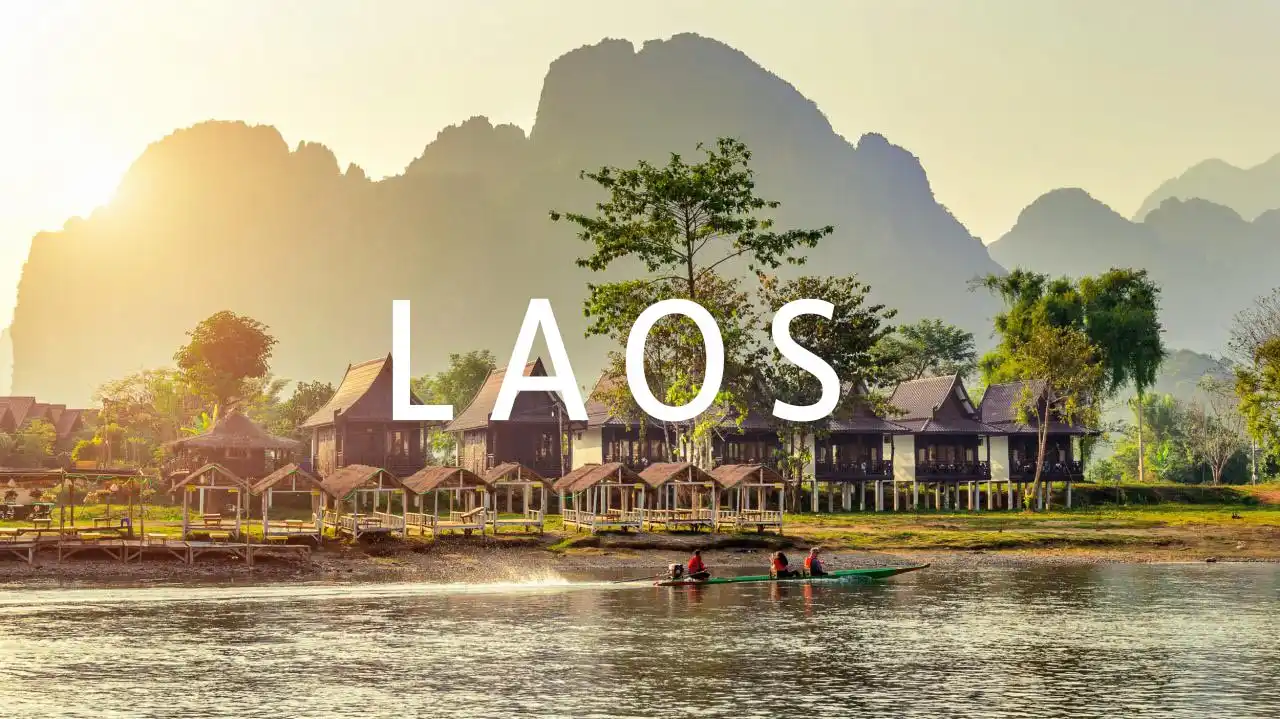
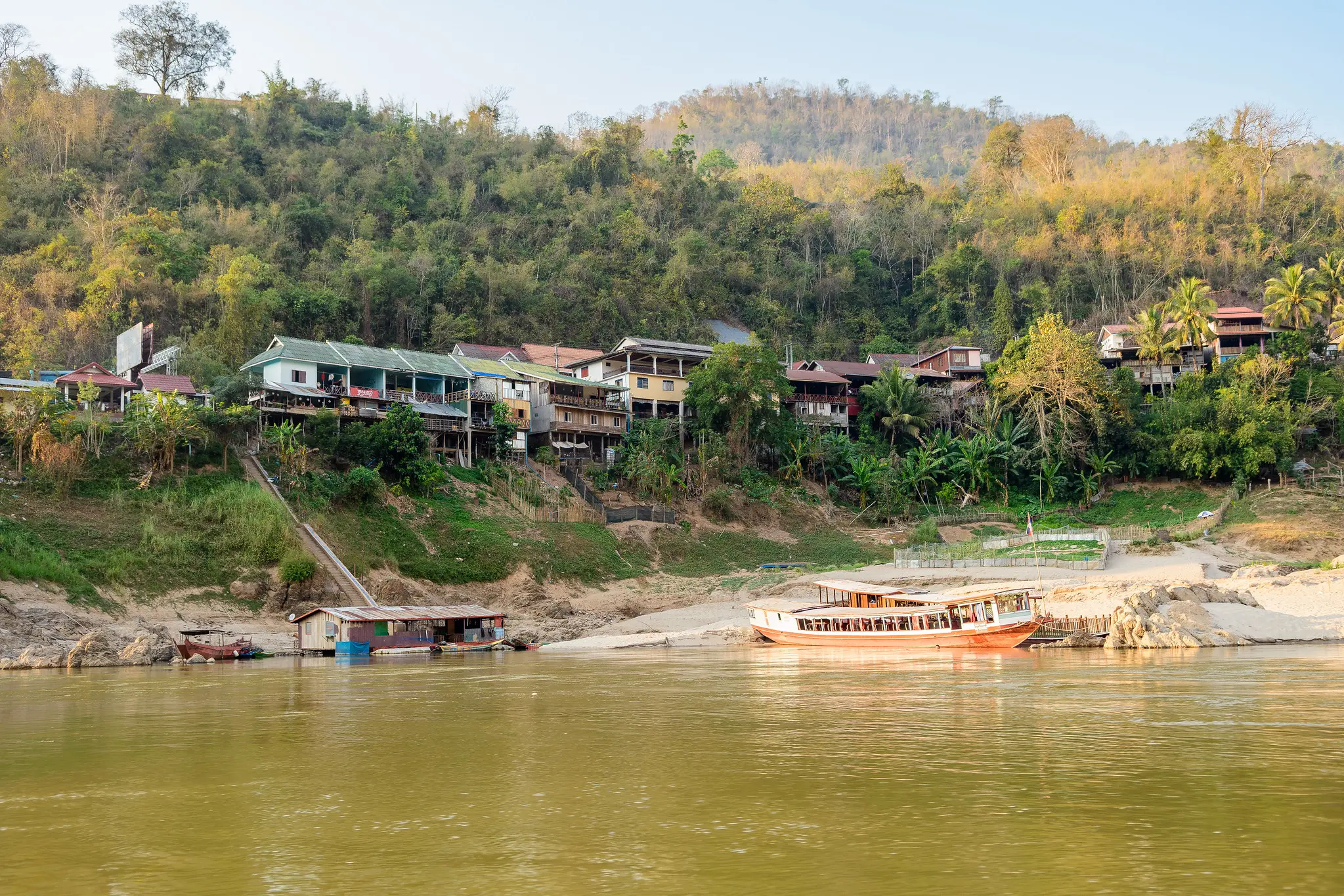
Traveling by slow boat from Huay Xai to Luang Prabang is the most scenic way to enter Laos. Here is everything you need to know about the two-day river journey, from river conditions and seasonal weather to choosing between public passenger boats and boutique cruises.
What is the Huay Xai to Luang Prabang river journey?
For decades, the Mekong River has served as the main highway of Northern Laos. Roads through the northern mountains are winding, bumpy, and prone to landslides during rainy months. Traveling by water remains the classic way to reach the UNESCO World Heritage town of Luang Prabang from Thailand.
The river route begins at Huay Xai, a small border town located directly across the Mekong from Chiang Khong, Thailand. From there, the river winds southeast through untouched tropical forests, steep limestone gorges, and remote ethnic villages.
The entire voyage covers approximately 280 kilometers (174 miles). Because the river features rocky shoals, shallow sandbanks, and strong currents, commercial passenger navigation after sunset is strictly prohibited. Every boat must dock overnight halfway at the riverside settlement of Pakbeng.
For modern travelers, this two-day is a true slow travel experience. Instead of rushing through airport terminals, you sit on the open river, watch water buffalo swim along muddy banks, and observe daily life in communities that have no road access.

SLOW TRAVEL IN ASIA
Discover why navigating Asia by water offers the ultimate immersive cultural experience.
Public slow boat vs. Boutique cruise: The honest truth
Before booking, you must understand the major difference between taking the public ferry and joining an organized boutique cruise. Both follow the same stretch of water, but the comfort and overall experience are completely different.
| PUBLIC SLOW BOAT | BOUTIQUE CRUISE |
|---|---|
| Cost: ~$25 – $30 (boat only) | Cost: $160 – $480 (all-in) |
| Seating: Old car seats, crowded | Seating: Dining tables & sofas |
| Engine: Very loud at the back | Engine: Well-insulated |
| Food: Bring your own snacks | Food: Hot cooked Lao buffet |
| Hotel: Find your own in Pakbeng | Hotel: Curated lodge included |
The public slow boat
The public boat is the traditional backpacker choice. These long wooden vessels, often called long-tail sampans, measure around 30 to 40 meters long. They carry both local villagers and international travelers, along with cargo like sacks of rice, vegetables, and even motorbikes.
Seating on public boats usually consists of recycled automobile seats taken from old minivans, placed loosely on wooden planks. These seats are not fixed to the floor, meaning they can shift as people move around. Space can be extremely tight during peak tourist season (December to February). If the boat fills up, late arrivals might end up sitting on hard wooden floorboards or right next to the diesel engine at the stern. The engine noise in the rear third of the boat is intense, making conversation impossible without earplugs.
Furthermore, public boats do not serve cooked meals. Passengers must buy instant noodles, potato chips, and pre-packed sandwiches before boarding in Huay Xai.

The boutique Mekong cruise
If sitting shoulder-to-shoulder on an unpadded seat for eight hours sounds exhausting, boutique cruises provide a far superior alternative. Companies like Shompoo Cruise, Luang Say, and Nagi of Mekong use custom-built wooden river barges designed specifically for leisure.
Instead of packed automotive rows, these vessels feature wide open-air decks, proper dining tables, comfortable lounge chairs, and clean private restrooms. More importantly, boutique cruises are fully guided. Instead of staring at passing hills from a distance, your boat stops at remote ethnic minority villages, the sacred Pak Ou Caves, and traditional artisan workshops. At midday, staff serve a freshly prepared multi-course buffet of hot Lao cuisine, complete with river fish, local curries, and tropical fruit.
Comparing the top boutique Mekong cruises
Several reputable cruise lines operate regular departures on the Huay Xai to Luang Prabang route. To help you choose the right operator, here is how the leading providers compare. All prices listed below represent all-inclusive packages covering the two-day boat journey, excursions, onboard meals, and overnight lodging in Pakbeng.
| Cruise Operator | Style & Capacity | Overnight Lodging | Key Inclusions & Highlights | Price per person |
|---|---|---|---|---|
| Nagi of Mekong | Traditional wooden boat (Up to 30 guests) | Choice of standard hotel or Sanctuary Pakbeng Lodge | Reserved cushioned seats with guest names, border visa assistance, luggage handling, freshly cooked lunch buffet. | $160 – $207 |
| Shompoo Cruise | Custom teak boat (Up to 40 guests) | Mekong Riverside Lodge (or partner riverside hotel) | Excellent onboard Lao cuisine, spacious dining tables, guided stops at Kamu villages and Pak Ou Caves. | From $207 |
| Le Grand Cruise | Boutique luxury craft (Small group / Private) | 4-star Le Grand Pakbeng Resort | Overnight stay in luxury cliffside villas with infinity pool, handcrafted local wooden boat, gourmet meals. | $220 – $280+ |
| Luang Say Cruise | Premium heritage barge (Up to 40 guests) | Luxury Luang Say Lodge | Classic upscale colonial experience, overnight in French-Lao teak bungalows, multi-course riverside dinner. | $370 – $480 |
Detailed cruise operator profiles
Choosing the right boat comes down to your budget and preferred style of travel:
Nagi of Mekong: Nagi is widely considered the best value upgrade over the public ferry. Their defining feature is personalized service: when you board, you will find your own comfortable cushioned chair with your name written on a reservation card. Their team assists with border crossing logistics at Huay Xai, carries your heavy luggage, and provides fresh coffee, tea, and fruit all day.
Shompoo Cruise: Shompoo consistently earns top reviews on international travel forums for its exceptional culinary service and warm hospitality. The boat feels like a floating restaurant, with sturdy wooden tables where you can eat comfortably, play cards, or write in a journal.

Le Grand Cruise: Operated in connection with the prestigious Le Grand Pakbeng Resort, this package appeals to travelers who prioritize high-end hotel comfort. After a relaxing day on the river, a private vehicle transfers you up the hill to a luxury villa overlooking the Mekong valley. You can swim in an infinity pool while watching the sunset before dining on fine Lao-French cuisine.
Luang Say Cruise: Luang Say is the original luxury pioneer of the Upper Mekong. Their magnificent 34-meter wooden barge is built entirely of polished teak and rosewood. Overnight guests stay in private raised timber chalets at Luang Say Lodge, nestled directly into the jungle canopy above the water.
EXTEND YOUR RIVER JOURNEY
Want a longer voyage? Check out our Multi-day Laos river cruise itinerary for options that include overnight stays on board.
The 2-day itinerary slow boat from Huay Xai: What you actually experience
Day 1: Huay Xai to Pakbeng
Morning:
Your journey begins early in the morning. If you stayed across the border in Chiang Khong, Thailand, your driver brings you to the international border crossing at the Fourth Thai-Lao Friendship Bridge. After clearing Lao immigration and securing your tourist visa, you transfer to the main boat pier in Huay Xai.
Boutique cruises welcome guests aboard around 9:00 AM. As the crew casts off the heavy mooring ropes, the boat glides into the main current. Early morning on the river is magical: cool mist rises from the dark water, and the jungle hills appear in layered shades of deep green.
Crew members serve hot Lao coffee, tea, and warm pastries as you settle into your seat. During the first two hours, the river marks the international border between Thailand on your right and Laos on your left, before turning fully into Laotian territory.


Midday: Riverside village exploration
Around noon, the aroma of lemongrass, ginger, and garlic fills the boat as the crew sets out the hot lunch buffet. You eat lunch at leisure while watching fishermen cast circular nets from slender wooden dugout canoes.
In the early afternoon, the captain maneuvers the vessel toward a sandy riverbank near Ban Kang Lae. This is a traditional settlement of the Kamu people, one of the oldest ethnic groups in Laos. Accompanied by your guide, you walk along red dirt paths past houses built on tall timber stilts.
Your guide explains how villagers harvest forest cardamom, weave bamboo fish traps, and dry river weed (Khai Paen) in the sun. Because boutique operators work directly with village elders, visits are respectful and welcoming.
Afternoon & Evening: Arriving in Pakbeng
Returning to the boat, you spend the remaining afternoon reading, relaxing, or chatting with fellow travelers on the open-air viewing deck. The river narrows as you enter steep rocky gorges.
Just before sunset, around 4:30 PM, the boat rounds a wide bend to reveal the small town of Pakbeng climbing up the hillside. Your crew secures the boat at the private docking station. Staff members transfer your luggage directly to your lodge or hotel, leaving you free to walk up the bank unburdened.
After checking into your room, you can enjoy a cold Beerlao on your balcony, watch the colors of the twilight reflect on the water, and fall asleep to the sound of crickets and flowing water.

Day 2: Pakbeng to Luang Prabang
Morning: Upstream navigation
You wake up to the sound of roosters crowing across the valley. Down at the riverbank, dense white morning fog covers the water like a thick blanket. If your lodge faces the river, you might spot domestic elephants from the local conservation camp walking down to the riverbank for their morning bath.
Following a hearty breakfast, guests board the boat at 8:00 AM. As the boat pulls away into the swirling current, the sun gradually burns through the morning mist. This second day of cruising covers a wider section of the Mekong. The landscape transitions from wild jungle into rolling agricultural hills planted with teak trees, banana groves, and mountain rice.

Midday: Riverside village exploration
Lunch is served on board around 12:30 PM as you approach the village of Ban Xang Hai, colloquially known as the “Whisky Village.” Stepping ashore, you can observe local women operating wooden foot-treadle looms, weaving silk and cotton scarves with intricate geometric patterns.
Further down the path, local distillers demonstrate how they ferment sticky rice in large earthenware jars to produce Lao-Lao, the potent traditional rice moonshine. You will have the opportunity to sample a sip if you are feeling adventurous.
Afternoon: Luang Prabang Arrival
A short cruise downstream brings you to the dramatic limestone cliff of Pha Xuang, located directly opposite the mouth of the Nam Ou River. Here lie the sacred Pak Ou Caves (Tham Ting and Tham Theung).
Carved deep into the vertical rock face, these two limestone caverns have served as a Buddhist pilgrimage site for over five hundred years. When local villagers fled historical invasions, they hid their family Buddha statues inside the caves for protection. Today, thousands of wooden, stone, and bronze Buddha statues stand crowded together on natural rock shelves.
Return to the boat for the final hour of sailing. Around 4:30 PM, your boat docks at the main pier just outside central Luang Prabang. Private minivans meet cruise passengers at the dock, delivering you o your hotel.

LUANG PRABANG TRAVEL GUIDE
Once you arrive, explore the best temples, night markets, and waterfalls with our comprehensive guide to Luang Prabang.
Best time to travel from Huay Xai to Luang Prabang
The experience of a slow boat from Huay Xai changes dramatically depending on the time of year. Northern Laos experiences three distinct weather seasons:
| Season | Months | River conditions and weather | What to expect |
|---|---|---|---|
| Cool season | Nov – Feb | • Pleasant 20°C – 28°C (68°F – 82°F) • Blue skies, minimal rain • Cold morning river fog |
• Best overall cruising weather • Cold early mornings (below 12°C) • Highest tourist crowds |
| Hot, dry season | Mar – May | • Hot, exceeding 35°C (95°F) • Shallow water and exposed sandbars • Seasonal agricultural haze |
• Slower cruising around rocks • Hazy mountain views • Low water operational delays |
| Green season | Jun – Oct | • Warm with tropical downpours • High water levels and fast currents • Lush emerald mountain scenery |
• Fastest downstream cruising • Fewest tourists on the water • Possible flood and debris warnings |
Cool season (November to February) – The ideal window
This is the most popular time to take the slow boat from Huay Xai to Luang Prabang. Daytime weather is comfortable with clear blue skies. However, mornings and evenings on the open river can feel remarkably chilly, with temperatures sometimes dropping below 12°C (54°F).
Pack a warm fleece or light windbreaker for morning departures. Because this is peak travel season, boutique cruises and Pakbeng lodges sell out weeks in advance.
Hot season (March to May)
By mid-March, daytime temperatures frequently surpass 35°C (95°F). This period marks the lowest water levels of the year on the Upper Mekong. Exposed granite boulders, rocky shoals, and shallow sandbars force captains to navigate cautiously, which often adds one to two hours to the trip.
Additionally, seasonal agricultural burning in the surrounding hills creates a smoky haze that can obscure mountain vistas.

Green season (June to October)
Tropical rains transform the northern landscape into vibrant emerald hills and fill cascading waterfalls along the riverbanks. High water levels create a swift current, which often reduces downstream travel time by up to two hours.
However, travelers must note critical safety considerations during the late monsoon peak (August to September):
- Upstream suspensions: While downstream boats from Huay Xai usually navigate safely with the current, upstream boats from Luang Prabang to Huay Xai are frequently suspended due to dangerous headcurrents.
- Submerged piers: Extreme flooding can submerge concrete boarding steps in Pakbeng, causing short operational delays until waters recede.
EXTEND YOUR ADVENTURE
Connect your Huay Xai river journey with a land tour exploring the highlights of Northern and Central Laos
Essential practical tips for your Mekong journey
Border crossing logistics between Thailand and Laos
The international crossing between Chiang Khong (Thailand) and Huay Xai (Laos) is straightforward. The border is open daily from 6:00 AM to 10:00 PM.
Most nationalities can obtain a 30-day Lao Visa on Arrival (VOA) at the immigration checkpoint on the Lao side of the bridge. The visa fee is approximately $40 USD, depending on your nationality.
Important: Bring clean, crisp US dollar bills without any tears, folds, or markings, as immigration officers will reject damaged notes. You will also need one passport-sized photograph. Alternatively, you can apply online for an official Lao eVisa at least five days before your departure.

VISA PREPARATION
Prepare your documents in advance. Check our guide on the Laos eVisa requirement before you cross the border.
Money and cash
There are no ATMs or bank branches once your boat leaves Huay Xai until you arrive in Luang Prabang. While your boutique cruise includes all meals, you will want small cash for purchasing cold drinks, handcrafted textiles in villages, or tipping your guide and boat captain.
Carry small denominations of Lao Kip (LAK) or Thai Baht (THB). Thai Baht is widely accepted in border shops, in Pakbeng, and at riverside village stalls.
Smart packing checklist
- Warm outer layer: A light down jacket, fleece, or windbreaker is essential for cold morning departures between November and February.
- Sun protection: Sunglasses, wide-brimmed sun hat, and high-SPF sunscreen. The reflection of sunlight off the water can cause sunburn even on overcast days.
- Slip-on footwear: Choose comfortable sandals or slip-on shoes. You will need to take off your shoes when stepping inside temple caves and traditional village stilt homes.
- Power bank: While some boutique boats offer charging stations, having a portable power bank ensures your camera and phone stay charged for two full days of photography.
- Bug spray: Mosquito repellent containing DEET is helpful during evening stops in Pakbeng.
Experience Laos cruise with Travel Sense Asia
A river cruise along the Mekong allows you to slow down, connect with indigenous heritage, and witness a timeless way of life that cannot be seen from a highway.
Whether you prefer a charming boutique day-cruise with warm Lao hospitality or a multi-day luxury voyage on a private expedition vessel, Travel Sense Asia can seamlessly weave the slow boat from Huay Xai into your broader Indochina itinerary.
Contact Travel Sense Asia today to craft your personalized journey through Laos and Southeast Asia.
Frequently Asked Questions
What is the typical slow boat Huay Xai schedule?
Most scheduled cruises depart Huay Xai between 8:30 AM and 9:30 AM on Day 1, arriving in Pakbeng around 4:30 PM. On Day 2, boats depart Pakbeng around 8:00 AM and reach the Luang Prabang pier between 4:00 PM and 4:30 PM.
Is the Pakbeng overnight boat stop mandatory?
Yes. The Pakbeng overnight boat stop is required for all passenger vessels. The Mekong River between Huay Xai and Luang Prabang contains dangerous rocks and sandbars, making navigation after dark illegal and unsafe. No commercial boat travels the entire distance in a single day.
Can I travel upstream from Luang Prabang to Huay Xai?
Yes. Both public boats and boutique cruises operate upstream departures from Luang Prabang to Huay Xai. Because boats travel against the river current, upstream travel takes roughly one to two hours longer each day than traveling downstream.
Which side of the boat has the best views?
Both sides offer spectacular views of limestone cliffs, jungle foliage, and rural settlements. When traveling downstream, the right side faces Thailand during the initial morning stretch, while both sides offer panoramic views once you enter deep Laotian territory.
Is the slow boat safe for older travelers and families?
Boutique cruises are exceptionally safe, stable, and comfortable for senior travelers and families with children. Vessels feature wide walkways, flat decks, clean Western-style toilets, and railings. However, public ferries can be difficult for travelers with limited mobility due to crowded seating and steep riverbank staircases.