







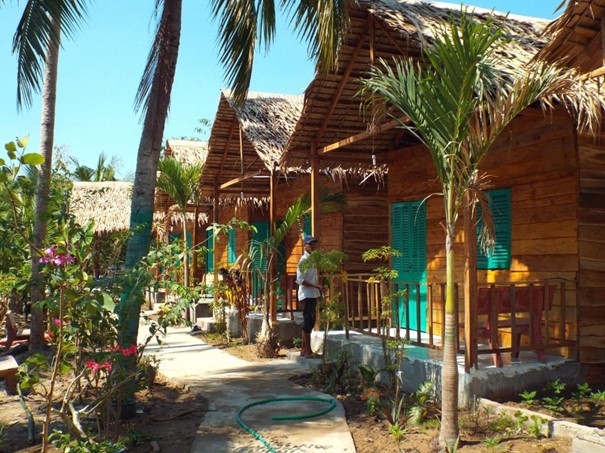
If Part 1 of our 10 days in Vietnam was about the chaotic symphony of Hanoi and the limestone majesty of Halong Bay, Part 2 is about silence, stamina, and soul. For our group of Italian travel writers, the transition was abrupt.
We left the flat delta behind and aimed our compass North, toward the frontier. We were heading to Hoang Su Phi (Ha Giang but now under Tuyen Quang), a region often whispered about but rarely truly seen by the average tourist. This wasn’t the famous “Ha Giang Loop” filled with backpackers on rented scooters that has flooded social media in recent years. This was a deeper, slower immersion into the ancestral lands of the Red Dao and H’mong people.
Meet the storytellers during 10 days in Vietnam
Before we climb the mountains, a quick reminder of whose eyes we are seeing this through:
1. Paola Bertoni (Paola in Viaggio | Instagram)
As a single mom and student pilot who once toured Europe in a camper van, she looks for freedom and adventure.
2. Cristina & Marcello (Vi do il Tiro | Instagram)
They are true travel veterans. Based in Bologna and married since 1988, they have been exploring the globe for decades.
3. Marina (The Travelling Petsitter | Instagram)
The daughter of an Alitalia captain (once the flag carrier of Italy), she grew up with luxury travel but now uses pet-sitting to unlock local experiences worldwide.
4. Veronica (Oggi dove andiamo? | Instagram)
A Ligurian soul with a heart for volunteering. She represents the responsible traveler who wants to give back.
5. Annalisa (Tre Valigie | Instagram)
A marketing expert who loves the seas. She sees travel through the eyes of a mother and a family planner.
6. Marina Loblundo (Maraina in Viaggio | Instagram)
As an archaeologist and a tea expert, for whom this leg of the trip was a dream come true.

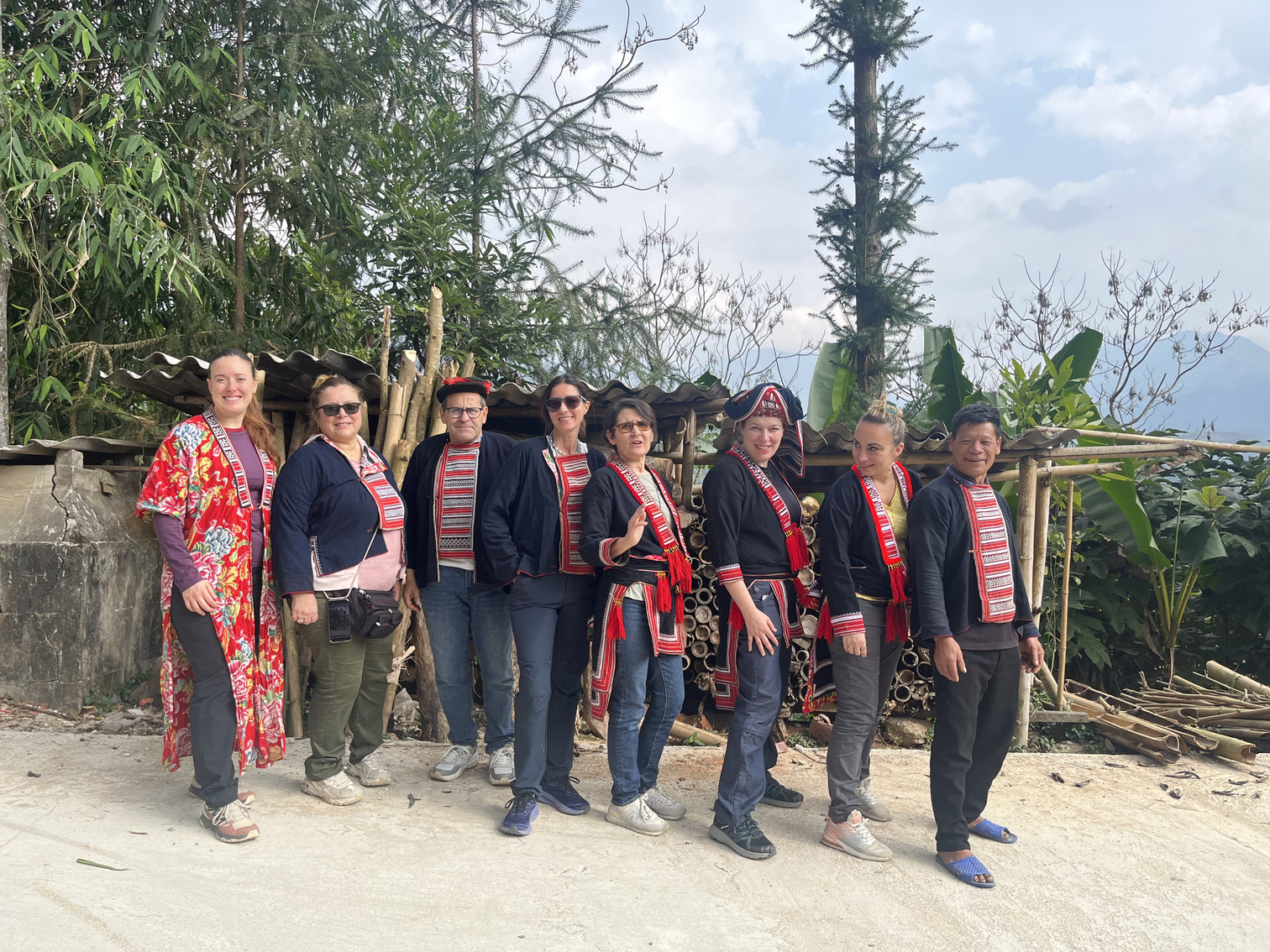
The Italian writers wearing the traditional Dao attires
Day 3: Hanoi – Hoang Su Phi – Panhou Retreat
Bidding farewell to the vibrant energy and modern pulse of Hanoi, our Italian writers boarded their van for a journey that would take them back in time. The drive, lasting over six hours, was a visual transition from the industrial to the pastoral. The tall, narrow tube houses of the capital gradually thinned out, surrendering their space to vast, emerald rice fields and rolling hills covered in lush vegetation.
The further north we drove, the more the road began to be challenging, winding around mountainsides where one window offered views of towering limestone cliffs and the other revealed valleys so deep they made the heart skip a beat. A brief nap shortened the journey, and before we knew it, the group arrived in Hoang Su Phi.
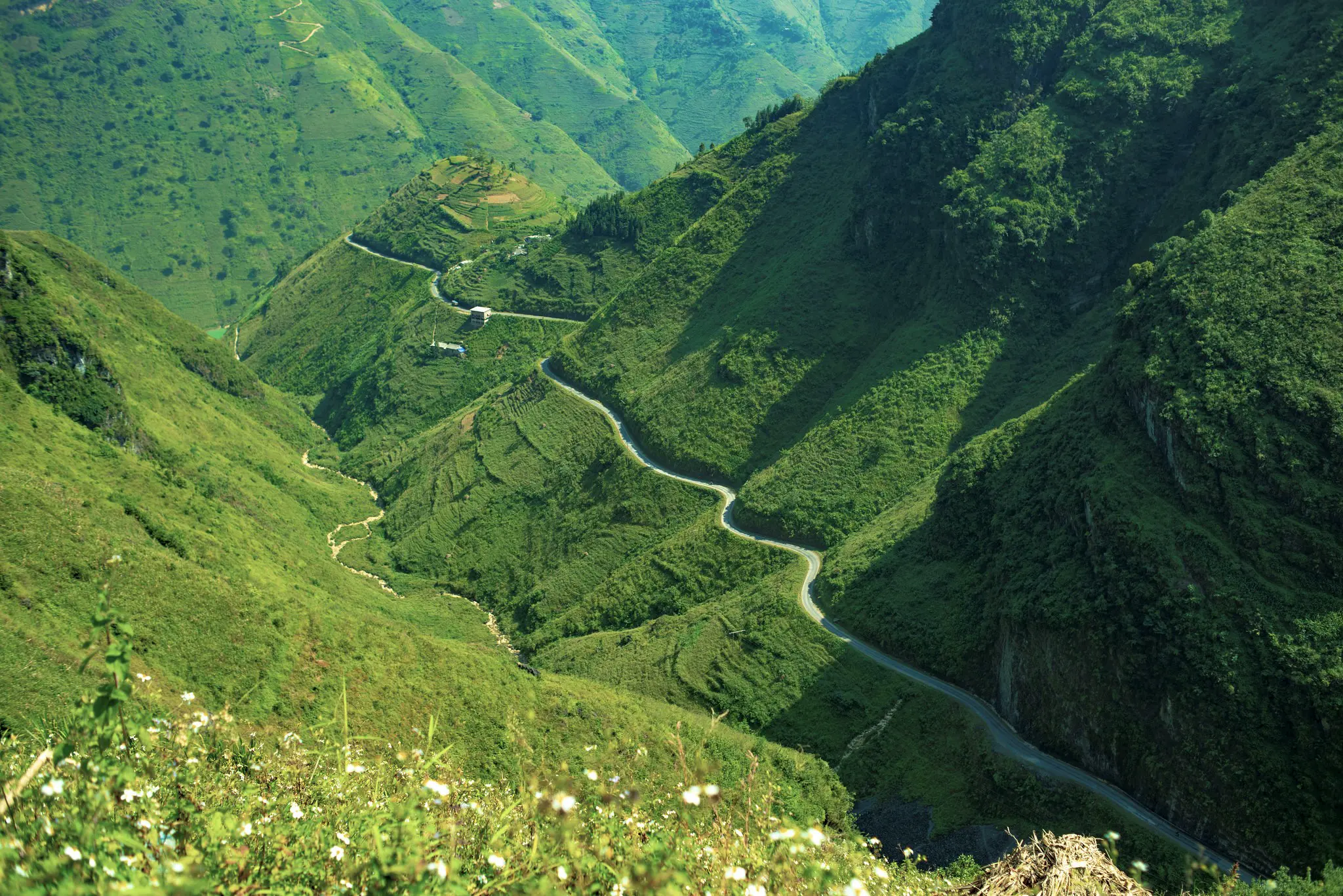
Winding roads heading to Ha Giang
A sanctuary in the jungle of Hoang Su Phi: Panhou Retreat
Welcoming the writers on their first day in the highlands was Panhou Retreat. This eco-lodge is a proud part of the Travel Sense Asia ecosystem and was recently honored as Asia’s Leading Green Resort 2025 by the World Travel Awards.
Crossing the wooden suspension bridge over a stream felt like stepping through a portal into a different world. On the other side lay the complete silence of Panhou, with bungalows nestled harmoniously amidst the dense vegetation. Every breath filled our lungs with the purest air nature can offer.
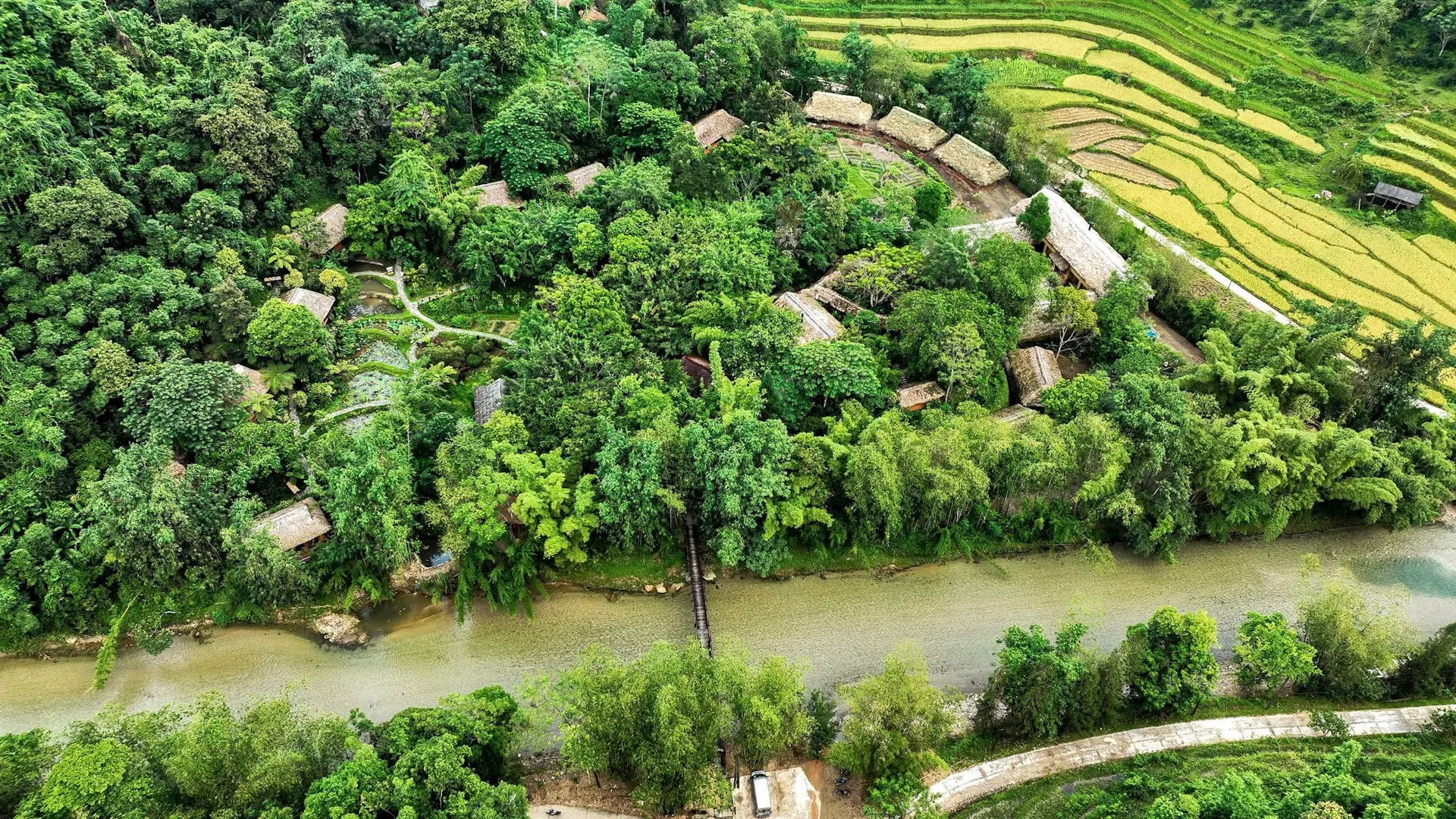
Panhou Retreat from above
What truly sets Panhou apart, however, is its focus on wellness which distinguishes this retreat from other mountain accommodations. Our writers immersed themselves in the local healing traditions, specifically the Red Dao herbal bath. This ancient medicinal recipe, a dark and fragrant brew of forest herbs, is designed to cure fatigue and stress. Others surrendered to release massages or relaxed in mineral water drawn from natural underground currents. The exhaustion of hours in the car simply evaporated in the steam.


The traditional Red Dao herbal bath

The day concluded with a cozy dinner by a warm fire at Khu Cao Restaurant, where local mountain dishes fueled the group for the explorations to come.

Inside Khu Cao Restaurant at Panhou Retreat
Day 4: Panhou Retreat – Nam Nghi – Phin Ho – Giang Ha
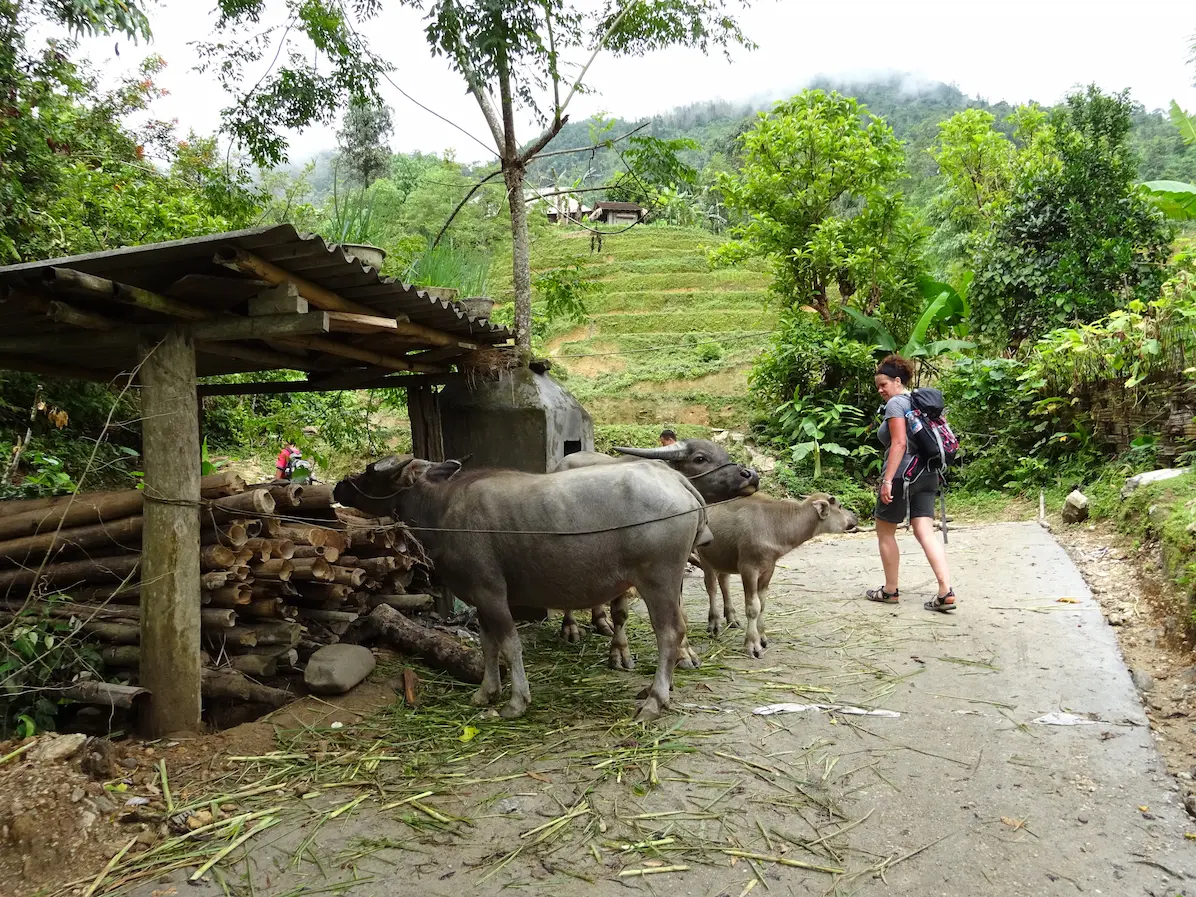
When we described Hoang Su Phi as undeveloped and wild, we meant it in the most literal and beautiful sense. The next morning, we embarked on a trekking journey from Panhou to the surrounding remote villages. For four hours, we navigated paths most of which were not paved for tourists but carved by the footsteps of locals over generations.
The natural treasure of Hoang Su Phi
We walked along the rims of breathtaking rice terraces that cascaded down the mountains like giant staircases and ventured deep into bamboo forests so thick the sunlight danced in dappled patterns on the ground. The path was raw, occasionally muddy, and at times seemed to disappear entirely, forcing us to rely on the knowledge of our local guide.

Our trekking trail in Hoang Su Phi
Our guide moved through this ecosystem with a profound connection that fascinated us all. With disarming ease, he would pause to forage for “mountain superfoods,” snacking on wild twigs, leaves, and berries that provided natural energy for the climb. He introduced us to the spicy, electric taste of fresh cinnamon bark stripped right from the tree and pointed out the wild banana groves, ginger patches, and small tobacco plants cultivated on the steep slopes. It was a masterclass in coexistence, showing us that for the locals, the mountain is both a home and a pharmacy.

A piece of cinnamon

How to wear the Dao head band

The rice terraces view
The ancient tea of Phin Ho
Midway through our journey, we paused to immerse ourselves in a different kind of culture at the Phin Ho Tea factory. Hoang Su Phi is famous for Shan Tuyet tea, so this part of the trip is unskippable. We were not just looking at bushes; we were standing among ancient tea trees, some hundreds of years old, their gnarled trunks covered in white moss, standing like silent guardians of the mountain.
Marina (Maraina in Viaggio), our tea connoisseur, was fascinated by the process. We learned how the local people climb these high trees to harvest the precious buds and process them with care. Tasting the tea right at the source was a revelation. The flavor profile was complex—an initial bitterness that transformed into a lingering, sweet aftertaste, much like the rugged life of the mountains itself. It was a taste of history in a cup.

Our visit to Fin Ho Tea factory
A night with the Red Dao in Giang Ha
By late afternoon, we reached Giang Ha, a small village where life is stripped of modern excess. We were welcomed by a family from the Red Dao ethnic minority, one of the oldest and most fascinating communities in Northern Vietnam. The Red Dao still live in isolated villages in the mountains, following a slow pace, ancestral traditions, and a strong sense of community. Their simple, open homes perfectly reflect their way of being in the world: little room for the superfluous, maximum value of sharing.

The kitchen of our homestay in Giang Ha
The homestay did not feel like a house in the Western sense of the word. It was an open, living, permeable space. There was no real separation between inside and outside, between domestic life and the world around us. We walked on simple surfaces, often made of rough concrete or rammed earth, while the fresh mountain air flowed freely from every side. The structure was a traditional stilt house; the lower floor served as the kitchen and communal living area, while the second floor was our sleeping quarters.
The “rooms” were essentially spaces separated by thick curtains, equipped with simple mattresses, blankets, and mosquito nets. For all of the writers, this simplicity was striking. In a place this remote, where life is hard, offering a dry, warm place to sleep to strangers is the ultimate form of luxury.

Modest “bedrooms” located on the upper floor of the house
The evening revolved around the kitchen: a dark, smoky, soulful room where the fire never truly goes out. It was raw, essential, and lived-in. There were no shiny surfaces or modern appliances, but everything worked with a disarming ease. This is where authentic dishes were prepared: freshly picked vegetables, mountain rice, and meats cooked without frills. It was the best meal of the day, seasoned with hunger and the genuine affection of our hosts.

Our dinner in the homestay in Giang Ha
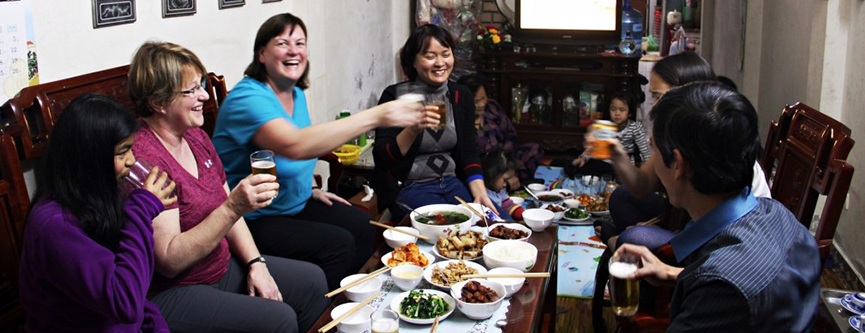
In the evening, everyone gathered around the food. Hosts, local guides, and guests sat together on very low, uncomfortable wooden stools, sharing dishes and passing them from hand to hand. No one was in a hurry; no one was checking their phones. Even though the host family didn’t speak English and we didn’t speak Dao, we understood each other perfectly. Later, glasses of rice wine, which they call “happy wine” in these parts, were passed from hand to hand. We cheered, laughed and got into the conversation without the need for translation.
Annalisa (Tre Valigie) said: “At that moment, it becomes clear that the true value of the experience isn’t the exoticism, but the authentic sharing.” We fell asleep to the sounds of the jungle, wrapped in thick blankets, feeling further from Italy than ever before, yet completely at home.
Day 5: Giang Ha – Panhou Retreat – Hanoi
Morning in the mountains breaks differently, with the crowing of roosters and the smell of woodsmoke. Due to our short itinerary, the next morning, motorbikes from Panhou Retreat navigated the rugged terrain to reach the homestay, picking up our writers to transport them back to the resort. There, they had a chance to freshen up and change before the long return to Hanoi.
On the road back to the city, the van was quieter than before. Many thoughts lingered in the minds of our Italian friends. They were leaving a place that was humble in material wealth but rich in spirit. The resilience and overwhelming hospitality of the mountain people had touched them deeply. They had seen a Vietnam that few tourists ever see, and they were carrying a piece of the highlands back with them to the delta.
Travel tips in Hoang Su Phi, Ha Giang | Suggested by travel writers
Here is the practical advice our Italian team wanted to share with you:
Prepare for a true expedition
You should know that the Ha Giang mountains are not accessible to everyone without preparation. This route features long, steep climbs that alternate between dirt paths and challenging rocky sections. The weather can turn a simple walk into a physical battle, especially on hot, humid days. Unlike the tourist centers, you will not encounter any towns for many kilometers. This isolation makes the experience authentic, but it also means self-sufficiency is key.
Annalisa


Pack for function, not fashion
In these rural areas, you cannot drag a suitcase. Everything must be carried in a backpack. Even if porters are provided, you must pack very lightly and leave anything fragile at home. The bags are often strapped together onto the back of a scooter to be transported up steep paths. The essential checklist includes a sleeping bag liner to place between the blankets and a microfiber towel, as the humidity can make drying off difficult. A high-capacity power bank is non-negotiable.
Paola
The necessity of a local guide
In the mountains, a homestay transports you to a world of ethnic minorities like the Red Dao, H’mong, and Tay. The language barrier here is immense; locals often do not speak Kinh (Vietnamese), let alone English. To truly understand the soul of this place, you need a guide just like in our case. Without local guidance, you are merely scratching the surface; with one, you unlock the stories behind the scenes, things that even many Vietnamese haven’t heard of or experienced.
Marina

Ten days in Vietnam is a true adventure for our Italian travel writers. It is a sprint through history, geography, and flavor. Vietnam is a country of contrasts, and we have only just begun to show you its layers.
Follow our series to discover:
Part 3: Danang, Hoi An, Hue
Part 4: Ho Chi Minh City, Mekong Delta
Would you like to plan a similar 10-day journey in Vietnam? Contact us here for a transparent, personalized consultation.