







If you are searching for the wild and authentic heart of Northern Vietnam, get ready to fall in love with Pu Luong. This Nature Reserve is a secret gem where terraced rice fields blend seamlessly with primeval forests and ethnic villages. It is not just a destination, but a total immersion experience, perfect to include in your next Vietnam tour.
In this detailed guide, Travel Sense Asia will take you on a virtual journey to discover the best attractions in Pu Luong and the top things to do in Pu Luong. You will also find out exactly when to visit Pu Luong, the best accommodation options, and logistical tips on how to get to Pu Luong without stress, even if you are planning an ambitious Vietnam tour from south to north.
Where is Pu Luong Nature Reserve?
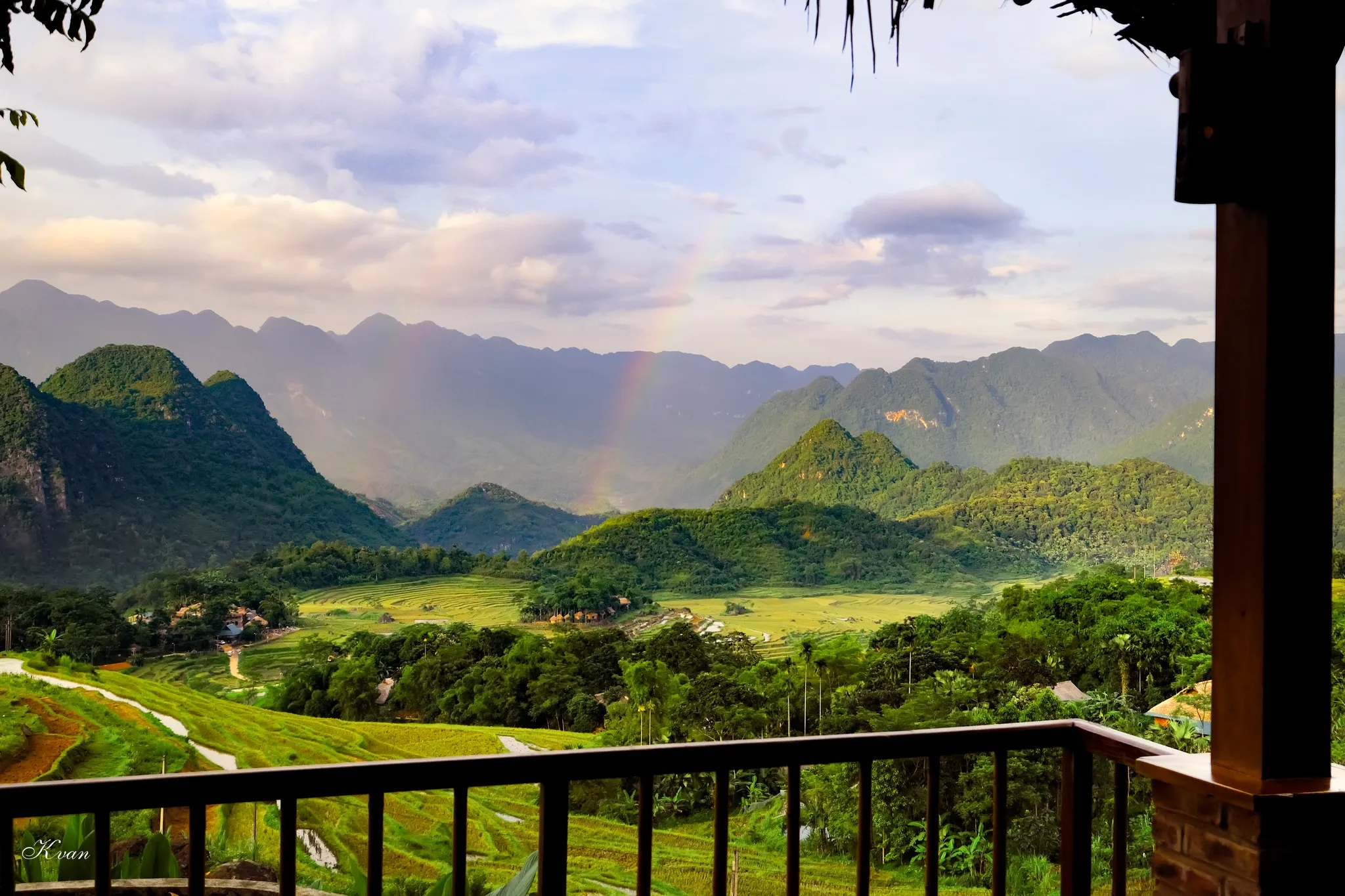
Pu Luong is a nature reserve located in the western part of Thanh Hoa province, in Northern Vietnam. It is renowned for its golden terraced rice fields, primeval forests, and the peaceful villages of the Thai ethnic minority.
Geographically, Pu Luong is about 160 km southwest of Hanoi. The journey takes about 3.5 to 4 hours by car via National Route 6, passing through winding mountain passes. The area is adjacent to well-known places like Mai Chau, allowing you to easily combine trekking with cultural experiences.
Thanks to this strategic location and breathtaking landscapes, Pu Luong has become a favorite destination for domestic and international visitors choosing a Northern Vietnam tour. It is especially beloved by those who enjoy trekking, photography, and authentic local culture.

The spectacular view of Pu Luong
How to get to Pu Luong? When the journey is the destination itself
If you are wondering How to get to Pu Luong, it is crucial to understand that the journey itself is a scenic adventure. Because the reserve is protected, the roads leading deep into the villages are narrow, winding, and sometimes steep. The presence of these mountain passes makes self-driving on a motorbike extremely risky for inexperienced riders, and local public buses are scarce and do not drop you off near the eco-lodges.
| Route & Starting Point | Estimated Travel Time | Expert Transport Advice & Scenic Stops |
|---|---|---|
| From Hanoi to Pu Luong | 4 – 5 hours | Private car with friver: The safest, most comfortable option. The route via National Highway 6 takes you over the spectacular Thung Khe Pass (White Rock Pass). *Expert Tip: Ask your driver to stop at the peak of Thung Khe. It feels like a snowy mountain due to the white limestone. Local Muong women sell hot boiled corn and bamboo-cooked pork here, a perfect mid-journey snack. |
| From Mai Chau to Pu Luong | 1.5 – 2 hours | Private transfer: This is a very popular connecting route. As you drive from the lower Mai Chau valley into the higher altitudes of Pu Luong, the temperature drops and the jungle thickens. It is highly recommended as part of a continuous Northern loop. |
| From Ninh Binh to Pu Luong | 3 – 3.5 hours | Private transfer: An incredible transition from the “Halong Bay on Land” to the deep mountains. Booking a private, all-inclusive tour via a trusted operator ensures your driver knows exactly how to navigate the narrow roads leading to your specific eco-lodge. |
EXTEND YOUR CULTURAL JOURNEY
Discover the neighboring peaceful valleys. Learn how to combine your trip with our comprehensive Mai Chau Travel Guide.
When to visit Pu Luong? Decoding the rice seasons
Unlike modern cities, the calendar in Pu Luong is not dictated by months, but by the ancient agricultural cycle of rice. The local farmers cultivate rice twice a year on the terraces that embrace the mountainsides. Deciding exactly When to visit Pu Luong means choosing which “color” of the valley you want to experience.

The Water Pouring Season
(February–March & July–August)
This is the mesmerizing phase when farmers direct water from the mountain streams into the terraced fields to prepare the soil. The terraces become thousands of sparkling mirrors, reflecting the blue sky, the drifting white clouds, and the silhouettes of farmers working with their buffaloes. As the young seedlings are planted, the mirrors slowly turn into a vivid, vibrant emerald green.
This season offers a profound sense of serenity, fresh mountain air, and a raw look at the essential beauty of agricultural life.

The Golden Harvest Season
(Late May–June & September–October)
These are undeniably the peak tourist windows. The two harvest seasons transform Pu Luong into an endless sea of gold. The layered terraces glow brilliantly under the sun, and the air is filled with the sweet, fragrant scent of ripe rice.
However, nature does not follow a strict corporate calendar. Each golden season lasts only about 2 to 3 weeks before the rice is cut. The September-October window is particularly stunning because it coincides with the breathtaking northern autumn. The weather becomes crisp, the skies are flawlessly clear, and humidity drops significantly, making trekking an absolute joy.
THE MAGIC OF AUTUMN
Discover why the harvest season in September and October creates the most perfect travel conditions in the North.
Deep exploration: Top attractions in Pu Luong
Pu Luong is vast, and many visitors make the mistake of just staying inside their eco-lodge. To truly experience the reserve, you must hike its hidden trails. Here is an expert breakdown of the most incredible Attractions in Pu Luong and the best Things to do in Pu Luong, going far beyond the standard tourist advice.

The giant bamboo water wheels of Ban Cong
Bamboo water wheels of Ban Cong
One of the most unique Things to do in Pu Luong is to walk along the Cham River to witness the giant bamboo water wheels (Cọn Nước). These are not tourist props; they are vital, functioning agricultural tools. Because the river sits lower than the terraced fields, the Thai people invented a brilliant, zero-electricity irrigation system.
They build massive wheels using bamboo poles, lashed together with flexible bamboo strips (no metal nails are used). The river’s natural current turns the wheel, and small bamboo tubes attached to the rim scoop up water. As the wheel reaches the top of its rotation, the tubes pour the water into an elevated bamboo aqueduct, which channels it into the rice fields.
Trekking the hidden valleys: Don, Uoi, and Lan Villages
While Don Village is the epicenter of tourism in Pu Luong, true adventurers should hike deeper. A highly recommended expert route takes you from Don Village down into the valley toward Uoi Village and Lan Village. This trek brings you through dense canopies of palm trees and unpaved dirt trails.
These villages see very little commercial traffic. Here, you can witness the traditional Black Thai stilt houses up close. These houses are elevated to protect against wild animals and floods, and their roofs are uniquely shaped like a turtle shell, an animal deeply respected in local animistic beliefs. Underneath the stilt houses, you will often find women working on traditional wooden looms, weaving incredibly intricate brocade fabrics using natural dyes extracted from forest plants like indigo.


The magnificent stalactites inside the Bat Cave
Kho Muong Village and the prehistoric Bat Cave
Kho Muong is perhaps the most isolated and visually stunning village in the reserve. It is hidden deep at the bottom of a massive limestone bowl, accessible only by a steep, zigzagging descent. The isolation has kept the village perfectly pristine.
Expert Tip: Do not just walk through the village. At the far end of Kho Muong lies the entrance to the Bat Cave (Hang Dơi). Formed over 250 million years ago, this massive karst cavern is home to at least four different species of bats. During the Vietnam War, its vast, hidden interior served as a secret revolutionary base and weapons cache. Today, exploring its echoing chambers filled with sparkling stalactites is an absolute must-do for adventurous souls.
EXPERIENCE PU LUONG IN PERSON
Ready to hike the terraces and sleep in a luxury eco-lodge? Check out our expertly crafted multi-day itineraries.
The geological secret of Hieu Waterfall
Hieu Waterfall is a breathtaking multi-tiered cascade hidden deep in the jungle. However, its most fascinating aspect is a geological secret: the water here contains an incredibly high amount of dissolved calcium carbonate.
Because of this constant calcification process, the rocks, tree roots, and riverbed over which the water flows are coated in a rough, porous layer of limestone. This means that, unlike typical mossy waterfalls, the rocks at Hieu Waterfall are not slippery at all. It is remarkably safe and incredibly fun to take off your shoes, walk barefoot directly up the cascading water, and swim in the natural crystal-clear pools formed at the base of the tiers.

The multi-tiered cascades of Hieu Waterfall

Son Ba Muoi: The “Mini Sapa” of Pu Luong
For the hardcore explorers, Son Ba Muoi consists of three deeply isolated highland villages (Son, Ba, and Muoi) situated at an altitude of 1,200 meters. The road to get here involves conquering the terrifyingly steep Pha He and Pha Chien passes.
Because of the altitude, Son Ba Muoi has a microclimate almost identical to Sapa, cool year-round, often covered in thick mist, and home to rugged, untamed landscapes. It remains completely uncommercialized, offering a raw, challenging, and deeply rewarding expedition.
RECOGNIZED BY THE VIETNAM NATIONAL AUTHORITY OF TOURISM
Travel Sense Asia is incredibly proud to be featured on the official Vietnam Tourism board as a trusted, premium, and expert travel partner.
The Culinary Delights of the Thai Highlands
Food in Pu Luong is not just nourishment; it is an extension of the forest and the fields. The cuisine is profoundly organic, emphasizing natural flavors, wood-fire cooking, and communal sharing.

Bamboo Tube Rice (Cơm Lam)
Glutinous rice is mixed with mountain spring water, stuffed into fresh bamboo tubes, and slow-roasted directly in the hot coals of a wood fire. The rice absorbs the sweet, fragrant aroma of the green bamboo and develops a slightly sticky, perfect texture. It is eaten by peeling away the charred outer bamboo layer and dipping the rice in crushed sesame salt (muối vừng).
Five-color Sticky Rice (Xôi Ngũ Sắc)
A true culinary art form. The rice is dyed using completely natural plant extracts: gac fruit for red, turmeric for yellow, magenta plant leaves for purple, and ginger leaves for green. It symbolizes the five fundamental elements of the universe and brings good fortune.
Cắp Nách” Pork & Grilled Chicken
These animals are not raised in factory farms. They roam freely on the hillsides, feeding on natural vegetation. This results in incredibly lean, tender, and flavorful meat. The pork is often roasted whole over charcoal until the skin is perfectly crispy, while the chicken is boiled with lime leaves or grilled with wild pepper (mắc khén), a spice unique to the northwestern mountains that leaves a slightly numbing, citrusy tingle on the tongue.

Where to stay: Suggested eco-retreats in Pu Luong
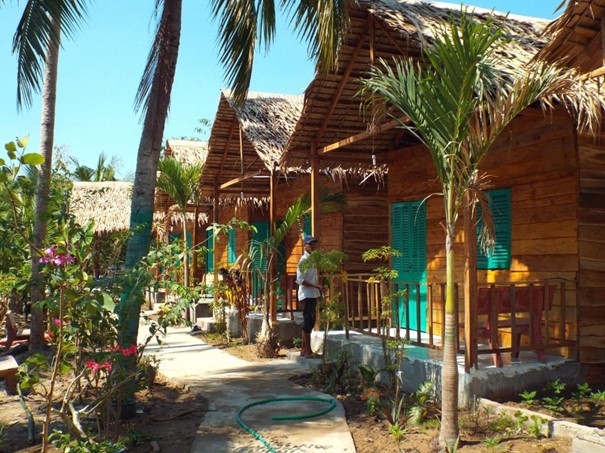
Despite its remote and protected status, Pu Luong offers incredible, high-quality accommodation that heavily focuses on sustainability. Concrete hotels are virtually non-existent; instead, you will find boutique eco-lodges built seamlessly into the landscape using local wood, thatch, and bamboo.
Pu Luong Retreat: The Pioneer
This is the most iconic and highly sought-after property in the area. It pioneered the luxury eco-tourism model in Pu Luong. It impresses with its stunning infinity pool that literally hangs over the edge of the terraced valley. The wooden bungalows are hidden among bamboo forests, offering no TVs or AC in some rooms, forcing a beautiful, sophisticated digital detox.
Pu Luong Eco Garden & Pu Luong Jungle Lodge
These properties also offer high-end comfort with deep respect for local aesthetics. They feature panoramic infinity pools and employ predominantly local Thai staff, ensuring that tourism dollars directly benefit the indigenous community.

Pu Luong Retreat
Plan your authentic escape to Pu Luong today
Pu Luong is a destination that truly embodies the wild, poetic beauty and the absolute tranquility of Northern Vietnam. It is the ultimate sanctuary for travelers desiring a digital detox, rewarding and challenging trekking, and deeply authentic cultural exchanges with indigenous minorities away from the massive tourist crowds.
If you are planning your Vietnam adventure, let the experts at Travel Sense Asia take care of every complex detail. We design highly personalized, safe, and sophisticated itineraries, ensuring that your journey through the mountains, from securing the most exclusive eco-lodges to arranging expert local guides, unfolds flawlessly. Contact us today to design a journey where every single step brings you closer to the true soul of Vietnam.
FAQ: Everything you need to know about Pu Luong
1. What is the real difference between Pu Luong and Sapa? Which should I choose?
Sapa offers the highest peaks in Indochina and incredibly challenging treks, but it has become a major city with heavy commercialization, large concrete hotels, and crowded streets. Pu Luong, by contrast, is a protected nature reserve. It is much smaller, far more remote, and incredibly quiet. There are no large tourist markets or aggressive street vendors here. If you want epic high-altitude mountain climbing, choose Sapa. If you want peaceful trekking amidst pristine golden rice fields, genuine cultural experiences, and a luxury eco-retreat vibe, Pu Luong is the absolute winner.
2. Are the Attractions in Pu Luong suitable for families with young children or elderly travelers?
Yes, but planning is required. If you choose a high-quality retreat with a pool, elderly travelers and children can easily enjoy the stunning views and take short, flat walks around Don Village. However, the deep treks to Kho Muong’s Bat Cave or the steep trails to Hieu Waterfall are rugged, unpaved, and highly demanding. They are not recommended for those with mobility issues or very small children without carriers.
3. What is the best way to get around inside the reserve?
For short distances between neighboring villages, walking is the best and most immersive way. However, attractions in Pu Luong are spread far apart across steep terrain. To reach distant spots like the water wheels or Hieu Waterfall, you should hire a local motorbike taxi (xe ôm) or use a private car provided by your tour operator. A private car guarantees maximum safety and air-conditioned comfort on the challenging mountain roads.
4. Does it make sense to include Pu Luong if I am doing a South-to-North Vietnam tour?
Absolutely. In fact, it is the perfect transitional destination. After visiting the bustling cities of the South and Central regions, and exploring the “Halong Bay on land” in Ninh Binh, Pu Luong offers a profound, refreshing contrast. Because it is located between Ninh Binh and Hanoi, it fits perfectly as a 2 or 3-day “nature detox” before you end your journey in the capital.
5. Do I really need to book accommodations far in advance?
Yes. The luxury eco-lodges in Pu Luong are small boutique properties, usually offering a few bungalows to minimize their environmental impact. During the golden harvest peak seasons (late May-June and Sept-Oct), the best retreats sell out completely up to 4 or 5 months in advance. Travel Sense Asia strongly advises planning and booking your complete itinerary early to secure the finest rooms with the best valley views.