












If you ask the local people about which islands in Vietnam that are the “cannot-miss”, most will mention a few famous names first. But the country’s island scene is much wider than that. Some islands are easy weekend escapes from Hanoi or Ho Chi Minh City, while others take more planning and feel much quieter once you arrive.
This guide covers a list of lesser-known islands across Northern, Central, and Southern Vietnam. For each one, you’ll find the practical details that matter most: where it is, how to get there, how long the trip takes, and what makes it worth adding to an itinerary when you travel to Vietnam.
Visit the region with the hidden islands – Northern Vietnam
Northern Vietnam is where many travelers start when exploring islands in Vietnam, and for good reason. Quang Ninh and Hai Phong have the country’s highest concentration of islands, with thousands scattered across Ha Long Bay, Bai Tu Long Bay, and Lan Ha Bay. Some are built around busy cruise routes, while others are better for a slower stay with beaches, fishing villages, and day trips on the water.
Quan Lan Island
Quan Lan is an inhabited island in Bai Tu Long Bay in Van Don, Quang Ninh. It is better suited to a quiet beach break than a packed sightseeing itinerary, with most trips built around the island’s beaches, seafood, and slower pace rather than major attractions.
| Practical Info | Details |
|---|---|
| Location | Van Don, Quang Ninh; in Bai Tu Long Bay |
| Main transportation | High-speed ferry from Ao Tien Port or other Van Don ferry points |
| Travel time | Around 3.5 – 4 hours from Hanoi to Van Don, then about 1–2 hours by speedboat/ferry |

Quan Lan Island, Quang Ninh
A useful thing to know about Quan Lan is that it sits in Bai Tu Long Bay, not on the main Ha Long Bay cruise circuit. That changes the feel of the trip quite a bit: the island is known more for long sandy beaches such as Quan Lan, Son Hao, and Minh Chau and for local village life than for crowded boat traffic.
For most travelers, the best plan is simple: spend time between Minh Chau Beach, Son Hao Beach, seafood meals, and easy rides around the island by tuk-tuk, electric car, or motorbike.
The best months in Quan Lan are usually late spring to early summer and early autumn, before the northern coast enters its stormier period.
LESSER-KNOWN BEACHES IN VIETNAM
Beyond the famous islands, explore Vietnam’s most serene and hidden coastal gems.
Find the most gorgeous islands in Central Vietnam
Central Vietnam has some of the country’s most interesting island trips because the islands here are very different from one another. One is known for volcanic landforms and garlic farms, another is a small island inside Van Phong Bay with no resident community.
Ly Son Island
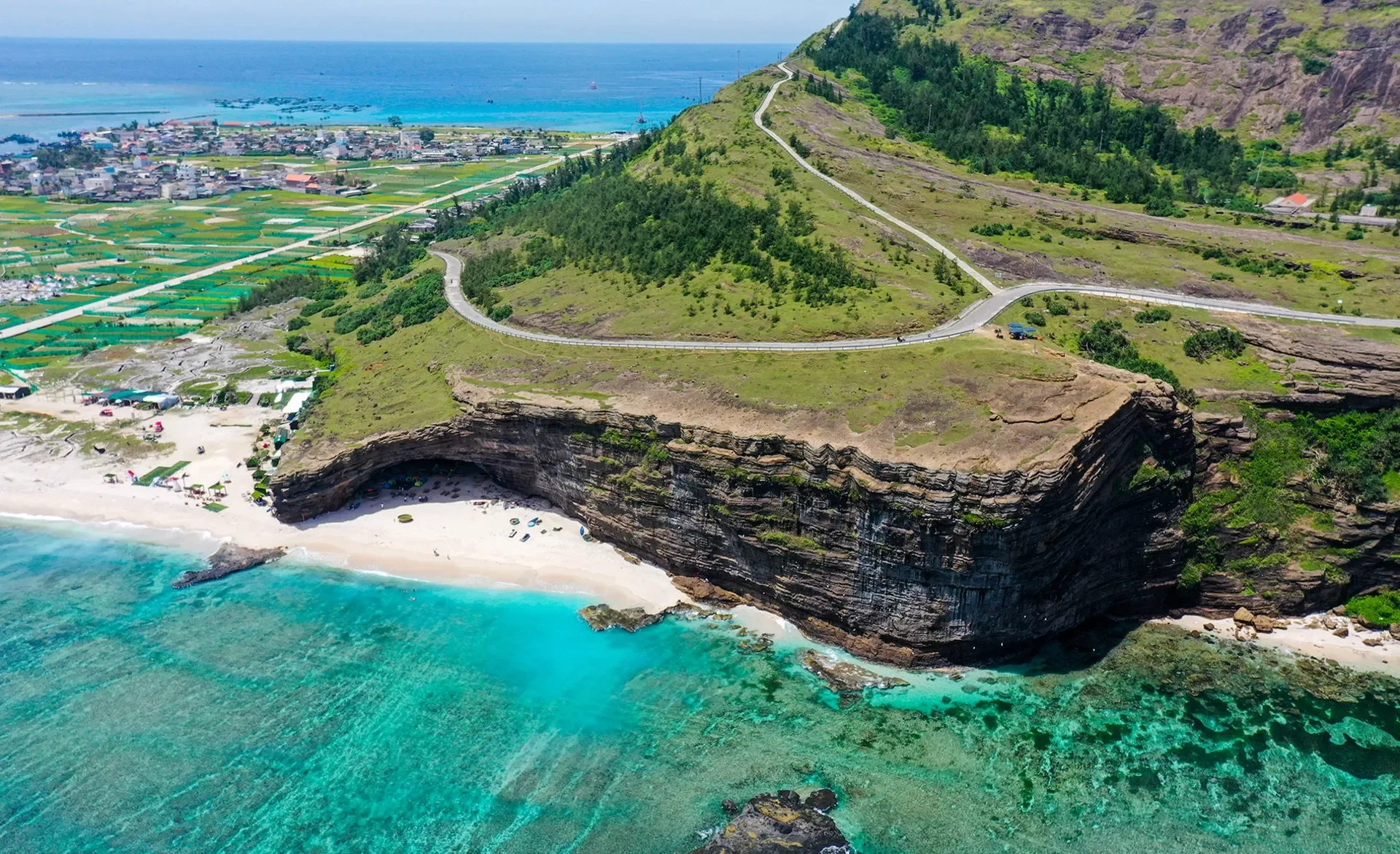
Ly Son is Quang Ngai’s island district, located about 15 nautical miles off the mainland. It is one of the most distinctive islands in Vietnam because the island was formed by ancient volcanic activity, and that geology still shapes the coastline, cliffs, and crater-like hills today.
| Practical Info | Details |
|---|---|
| Location | Off Quang Ngai Province |
| Main transportation | Speedboat from Sa Ky Port |
| Travel time | Around 35 – 45 minutes by speedboat from Sa Ky Port; longer if arriving from Da Nang or Chu Lai first |

Ly Son Island, Quang Ngai
What makes Ly Son stand out is that its main sights are tied directly to the island’s volcanic landscape. Thoi Loi Mountain sits on the rim of the island’s largest extinct crater and gives a wide view over the sea, garlic fields, and the freshwater lake on top. Other well-known stops include Hang Cau, where cliffs meet the shoreline, and To Vo Gate, a natural lava-rock arch often visited at sunset.
Ly Son is usually best when treated as a slow island trip rather than a beach-only stop. Travelers often rent a motorbike to move between the main island and viewpoints, then take a short boat ride to Dao Be (An Binh) for swimming and snorkeling.
The most reliable months are usually April to August, when the sea is calmer and speedboat crossings are less likely to be disrupted.
Whale Island (Hon Ong)
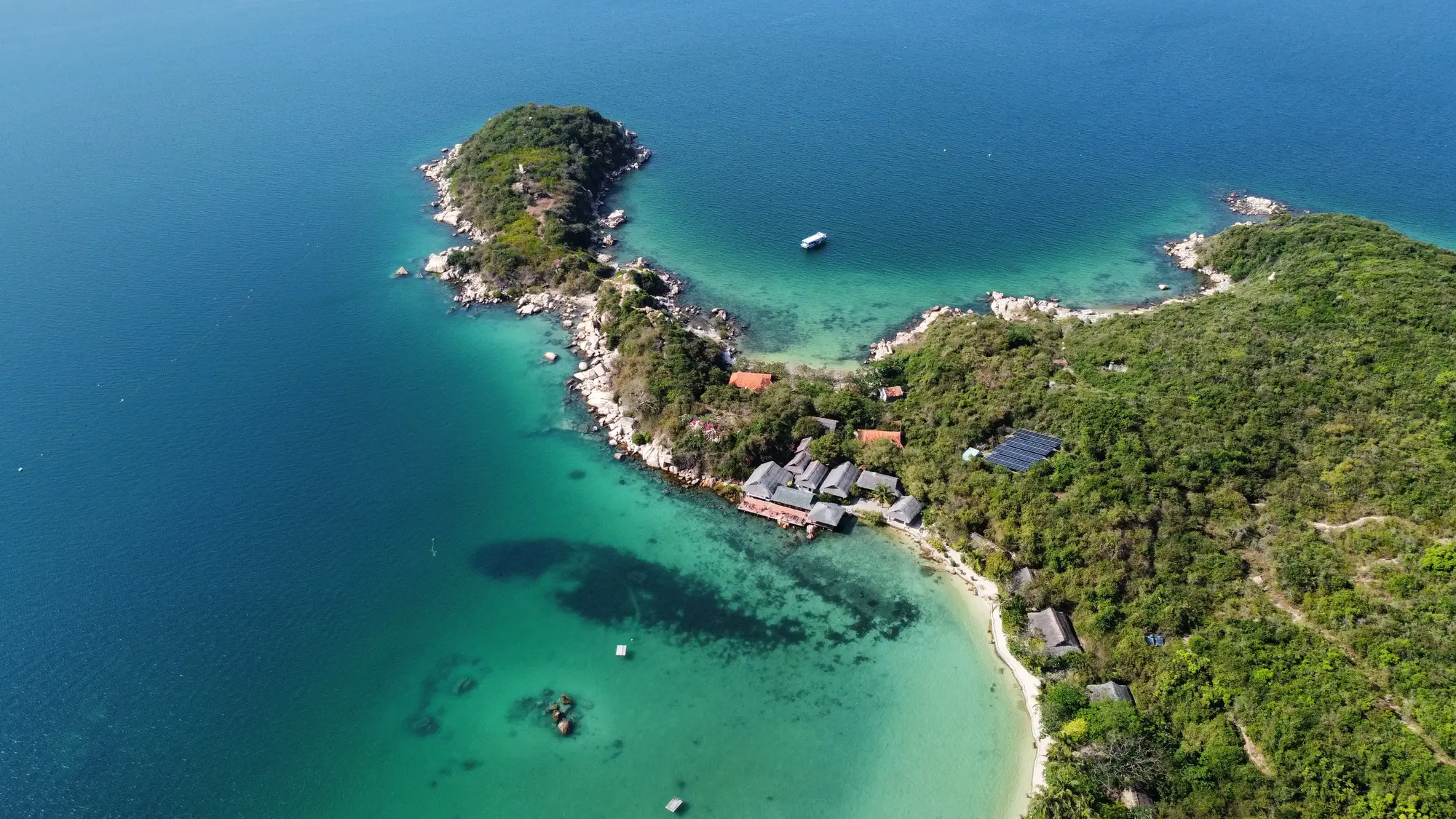
Whale Island, also known as Hon Ong, is a small island inside Van Phong Bay in Khanh Hoa. It is very different from larger island destinations because there is no resident town on the island, and most stays are built around a quiet beach break rather than sightseeing.
| Practical Info | Details |
|---|---|
| Location | Van Phong Bay, Khanh Hoa Province, around 100 km north of Nha Trang |
| Main transportation | Road transfer to the mainland pier in the Van Phong/Dam Mon area, then short boat transfer |
| Travel time | The boat transfer itself is usually 15–20 minutes; total travel time depends on where you start on the mainland |
Whale Island
If you are looking for a secluded island resort in Vietnam, this is the perfect match. The island features only one accommodation, built strictly with sustainable materials like bamboo and timber to protect the environment. You will not find televisions, loud beach clubs, or busy traffic here. It is a true digital detox where your day revolves around kayaking, hiking coastal trails, and relaxing by the ocean.
The island gets its name from the whales and whale sharks that historically visit the bay to feed on krill. For the best chance to spot these gentle giants and explore vibrant coral reefs, plan your trip between May and July. During these months, the sea is exceptionally calm with excellent underwater visibility for snorkeling and scuba diving.
EXPERIENCE WHALE ISLAND
Immerse yourself in tranquility with our bespoke tour featuring the stunning Whale Island.
Phu Quy Island
Phu Quy is an island district located roughly 103–120km off the famous Phan Thiet beach region, depending on the source and route used. It is farther from the mainland than many first-time visitors expect, which is one reason it still feels more local and less built around package tourism than better-known island destinations.
| Practical Info | Details |
|---|---|
| Location | Lam Dong Province (Off Phan Thiet) |
| Main transportation | Ferry or high-speed boat from Phan Thiet |
| Travel time | Usually 2–3.5 hours by high-speed boat (weather-dependent) |

Phu Quy Freediving
Phu Quy is not a typical single-beach destination where you stay in one spot. Instead, travelers usually rent a motorbike and explore its dramatic coastal roads. The landscape is a striking mix of black volcanic cliffs, white sand beaches like Trieu Duong Bay, and giant wind turbines spinning against the blue sky. You will spend your days visiting active fishing harbors, hiking up to the Linh Son Pagoda on Cao Cat Mountain for panoramic views, and eating incredibly cheap, fresh seafood directly from the local fishermen.
One of the most thrilling experiences on the island is exploring Ganh Hang, a rugged cliff area hiding natural saltwater “infinity pools.” You should plan your visit between March and May as the ocean is remarkably flat and calm, allowing you to safely climb the coastal rocks.
Cham Islands (Cu Lao Cham)
Cu Lao Cham is a group of eight islands off the coast of Hoi An. The islands are best known for being part of the Cu Lao Cham – Hoi An Biosphere Reserve, which UNESCO recognized in 2009 for its mix of marine, coastal, and island ecosystems. If you enjoy island hopping in Vietnam, this is an accessible and rewarding spot.
| Practical Info | Details |
|---|---|
| Location | Off Hoi An, Da Nang |
| Main transportation | Speedboat or wooden boat from Cua Dai Port |
| Travel time | Around 15–20 minutes by speedboat or longer by regular boat |

Cham Islands, Hoi An – Da Nang
What makes Cu Lao Cham different from many other island trips in Vietnam is that it is not just a beach stop. The archipelago is part of a protected biosphere area that links the islands with Hoi An’s coastal zone, and UNESCO notes that the marine area supports hundreds of species of fish, coral, shellfish, crustaceans, and seaweed. That is one reason snorkeling and diving are such a big part of the trip here, especially around coral areas off Hon Lao and nearby islets.
For most travelers, Cu Lao Cham works as either a day trip from Hoi An or a short overnight stay if the goal is to see the islands after the day-tour crowds leave. The main stops usually include Bai Ong, Bai Chong, local seafood lunches, and snorkeling sites, and the island also has small fishing communities and historical sites such as Hai Tang Pagoda.
TRUSTED BY THE VIETNAM NATIONAL AUTHORITY OF TOURISM
Travel Sense Asia is incredibly proud to be recognized on the official Vietnam Tourism board as a premium travel partner.
Most iconic islands to visit in Southern Vietnam
Southern Vietnam has the islands people usually save for the “proper beach trip” part of an itinerary. But Con Dao and Nam Du are not interchangeable. One is easier to justify if the trip is about nature, history, and a quieter stay with more structure. The other makes more sense if the goal is island hopping, simple seafood meals, and a looser, more local beach break.
Nam Du Islands
Nam Du is an archipelago in An Giang Province (often accessed via Rach Gia) in the Gulf of Thailand, made up of more than 20 islands and islets. It is one of Southern Vietnam’s more relaxed island trips, with most stays built around the main island, boat trips to nearby islets, and a few days of swimming, seafood, and riding around the coast by motorbike.
| Practical Info | Details |
|---|---|
| Location | An Giang Province (Gulf of Thailand) |
| Main transportation | High-speed ferry from Rach Gia |
| Travel time | Usually around 2–2.5 hours by speedboat from Rach Gia |

Nam Du, An Giang
Nam Du is an archipelago of over 20 scattered islands. Most travelers base themselves on the largest island, Hon Lon. Here, the highlight is renting a motorbike to ride the steep, winding coastal road that wraps around the island. You will eventually arrive at Bai Cay Men, a stunning crescent-shaped bay shaded by decades-old coconut palms, perfect for a lazy afternoon.
However, you cannot visit Nam Du without hiring a local wooden boat to hop between the smaller, uninhabited islets like Hon Mau and Hon Hai Bo Dap. The glassy waters allow you snorkeling over shallow coral reefs and catching the legendary golden sunsets from the deck of a fishing boat.
To get the absolute best out of this island-hopping experience, travel between January and March. During these dry season months, the Gulf of Thailand is as calm as a lake.
Con Dao
Con Dao is an archipelago of 16 islands and islets in Southern Vietnam, approximately 230km away from Ho Chi Minh City. It is one of the few island destinations in Vietnam where a beach trip, a national park visit, and a major historical site all sit in the same itinerary.
| Practical Info | Details |
|---|---|
| Location | Ba Ria – Vung Tau, Ho Chi Minh City |
| Main transportation | Flight to Con Son Airport, or ferry from the mainland |
| Travel time | About 1 hour by flight from Ho Chi Minh City; high-speed ferry from Soc Trang takes around 2 hours |

Con Dao, Ho Chi Minh City
What sets Con Dao apart is its incredible balance of deep history and protected nature. While the main island is home to the historically significant Con Dao prison complex, it is equally famous for the pristine Con Dao National Park. For a well-rounded 3 to 4-day trip, travelers can easily split their time between learning about the island’s past, hiking through lush jungle trails, and relaxing on the empty white-sand beaches.
Beyond its beautiful coastlines, Con Dao is Vietnam’s premier destination for marine conservation. The ultimate highlight here is watching endangered green sea turtles lay their eggs or helping rangers release baby turtles into the ocean. During the nesting and hatching season, visitors can book guided overnight eco-tours at the Bay Canh islet ranger station,
To witness this unforgettable natural event, plan your visit between July and September.
CON DAO TRAVEL GUIDE
Dive deeper into the history, pristine beaches, and turtle-watching seasons of Con Dao.
Best times to visit islands in Vietnam
Vietnam’s islands do not all follow the same weather pattern, so there is no single “best month” for the whole country. The easiest way to plan is to think by region.
For Northern islands
For islands in Quang Ninh and Hai Phong, such as Cat Ba and Quan Lan, the most comfortable time to visit is usually April to June and September to October. These months are warm enough for beach time and boat trips, but they usually avoid the coldest winter weather in the north.
July and August can still be good for swimming, but this is also when summer storms and heavy rain become more of a risk in Northern Vietnam.
For Central Vietnam islands
For islands in Central Vietnam, such as Ly Son, Cham Islands, Whale Island, and Phu Quy, the best time is often March to August. This is usually the driest and sunniest part of the year along much of the central coast, and it is also when boat crossings and water activities tend to be more reliable.
For Southern islands
For Southern islands such as Con Dao and Nam Du, the easiest season for travel is generally December to June. This is the dry season in much of Southern Vietnam, so the weather is usually sunnier, the sea is calmer, and ferry or speedboat services are less likely to be disrupted.
For islands like Nam Du, where the trip depends heavily on speedboat travel and island-hopping, weather can have a bigger effect on the overall experience than it does in places with direct flights like Con Dao.
BEACH WEATHER GUIDE
Unsure when to book your seaside escape? Check out our month-by-month guide to Vietnam’s beach weather.
FAQs
What is the best island to visit in Vietnam for first-time travelers?
If you want an easy first island trip, Cat Ba and Cham Islands are two of the most practical options because they fit well into popular routes in Northern and Central Vietnam. For a longer island stay, Con Dao is a strong choice if you want beaches, nature, and history in one trip.
Which islands in Vietnam are best for a short trip?
For a short trip, it is usually best to choose an island that sits close to your mainland route. Cham Islands work well from Hoi An, while Cat Ba is a convenient option from Hanoi. Islands like Phu Quy, Nam Du, or Con Dao are usually better with at least two or three nights.
Which island in Vietnam is best for beaches and swimming?
For beach time and swimming, Quan Lan, Nam Du, Con Dao, and Cham Islands are all good options depending on the season. The best choice often comes down to which region you are already visiting and how much travel time you have.
Which hidden island in Vietnam should you visit?
The island trip in Vietnam depends less on what is most famous, and more on what fits your route, travel pace, and the kind of trip you want to have.
With more than 15 years of experience designing tailor-made journeys across Vietnam, Travel Sense Asia creates island and coastal itineraries shaped around your interests, travel pace, and preferred style of stay. From choosing the right season and ferry routes to matching you with the islands that fit your itinerary best, our local specialists handle the planning in detail – so you can experience Vietnam’s islands in a way that feels genuinely rewarding.