









When it comes to travel to Thailand, Sukhothai takes you beyond the beaches and busy cities, where ancient temples, quiet countryside and centuries-old ruins come together. Cycling through the historic park, watching the ruins glow at sunrise and exploring local villages give travelers a chance to experience the past at a slower pace.
This travel guide to Sukhothai takes you through the atmospheric Sukhothai Historical Park and finds practical advice on how to get from Bangkok to Sukhothai, when to visit, and what to know before traveling to this beautiful country.
Where is Sukhothai Thailand and why visit?
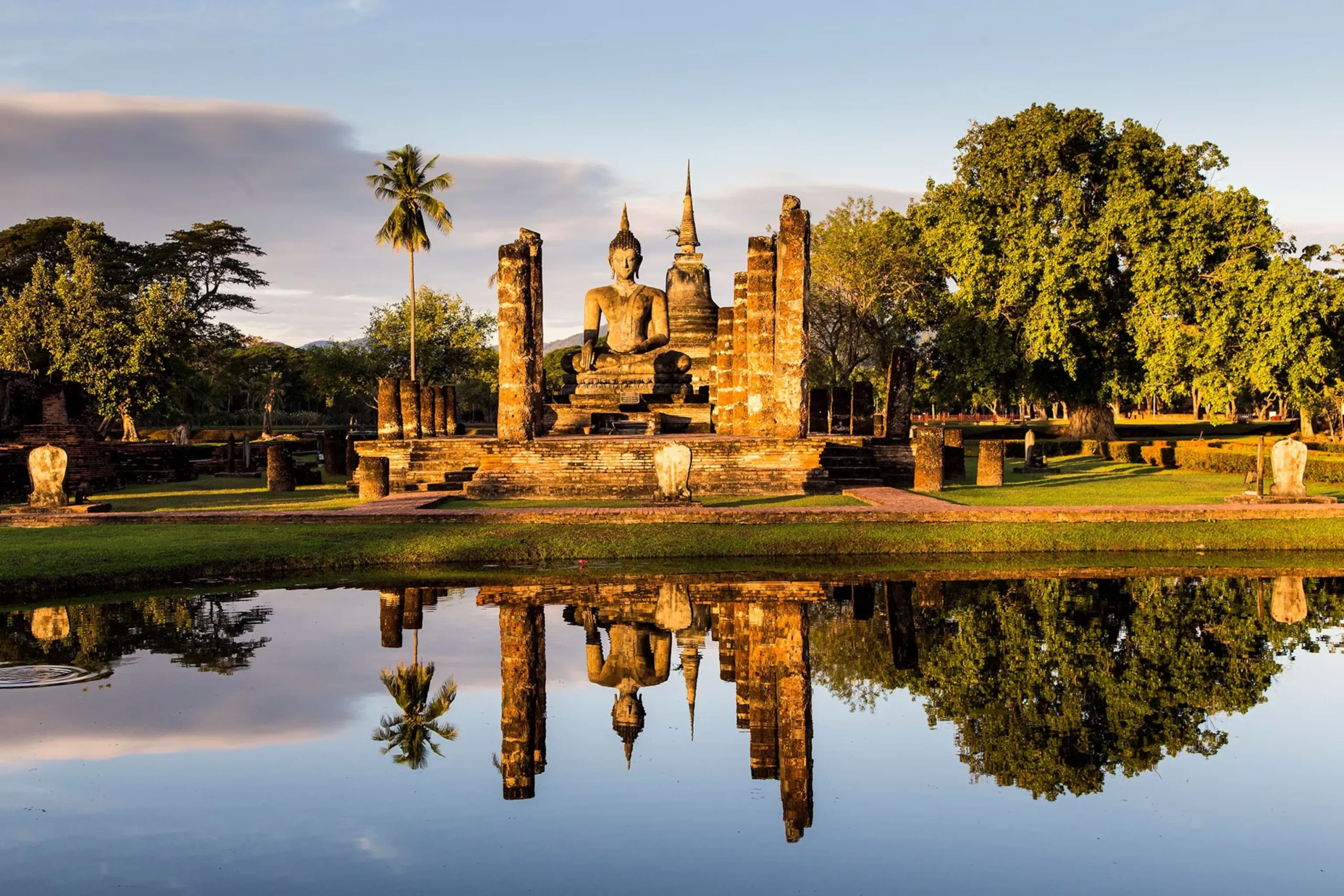
Sukhothai, meaning “Dawn of Happiness,” lies about 430 km north of Bangkok and was the capital of the first independent Thai kingdom from the 13th to 14th centuries. Founded around 1238, the city became an important center of Thai culture, Buddhism and architecture under King Ramkhamhaeng.
Today, the ancient capital is preserved as the Sukhothai Historical Park, a UNESCO World Heritage Site surrounded by trees, ponds and open countryside. Its distinctive lotus-bud chedis and graceful walking Buddha images give Sukhothai a quieter atmosphere than Ayutthaya, which makes it ideal for slow travel.

- Heritage status: UNESCO World Heritage Site since 1991
- Old vs New Sukhothai: Old Sukhothai (the ruins) and New Sukhothai (modern town, ~12 km east, with bus station and night market)
- Park size: About 70 km²; 5 zones, 3 of them ticketed
- Must-see temples: Wat Mahathat, Wat Sa Si, Wat Si Chum and Wat Saphan Hin
- Recommended stay: At least 1 night and 2 days
THAILAND REGIONAL WEATHER & SEASONS
Find out the best time to visit Thailand by region to plan your historical journey perfectly.
Sukhothai Historical Park: Zones, Entrance fees and Opening hours
As highlighted in this travel guide to Sukhothai, the Sukhothai Historical Park spans ancient temples, ponds and monuments across five zones: Central, Northern, Western, Southern and Eastern. The main park is generally open 06:30–19:30 Monday to Friday and Sunday, with Saturday hours extending to 21:00 for illuminated monuments and special evening events.
Central Zone: The main temple area
The Central Zone of Sukhothai Historical Park is the best place to start, with the largest concentration of iconic ruins inside the old city walls. Visitors can explore lotus-bud chedis, Buddha images, tranquil ponds and some of the park’s most atmospheric temples.

Wat Mahathat
- Ticket: 200 THB for foreign visitors
- Opening hours: Generally around 06:00–18:00.
- Wat Mahathat: The park’s largest and most important temple, known for its lotus-bud chedis and rows of Buddha images.
- Wat Sa Si: A graceful temple surrounded by water, especially atmospheric in the early morning.
- Wat Si Sawai: One of the oldest monuments in the park, featuring three distinctive Khmer-style prangs.
- Wat Trapang Ngoen: A smaller temple beside a pond, with a striking walking Buddha.
Northern Zone: Wat Si Chum and more
Located beyond the northern city wall, the Northern Zone of Sukhothai Historical Park is best known for Wat Si Chum and its enormous seated Buddha. It is a worthwhile addition to the Central Zone, especially for travelers interested in Sukhothai’s religious art and architecture.
- Ticket: 120 THB for foreign visitors
- Opening hours: 07:30–17:30 daily
- Wat Si Chum: Famous for its huge seated Buddha enclosed within a narrow mondop.
- Wat Phra Phai Luang: An extensive temple complex with distinctive Khmer-influenced architecture.
- Tip: Allow extra time here if you want to explore beyond the main temple.

Wat Si Chum

Wat Saphan Hin
Western Zone: Wat Saphan Hin
Among the five zones of Sukhothai Historical Park, the Western Zone is more spread out and slightly hillier, with forested ruins and fewer visitors than the Central Zone. It is a good choice for travelers seeking a quieter and more peaceful side of the park.
- Ticket: 120 THB for foreign visitors
- Opening hours: 08:00–16:30 daily
- Wat Saphan Hin: A short uphill walk leads to a large standing Buddha overlooking the surrounding countryside.
- Experience: The peaceful setting makes this zone particularly appealing in the cooler morning or late afternoon.
Southern & Eastern Zones: Smaller temple ruins
The Southern & Eastern Zones of Sukhothai Historical Park offer a quieter experience, with smaller temple ruins. It is less visited than the main zones, making it a good option for travelers with extra time who want to explore beyond the park’s highlights.
- Ticket: Free
- Opening hours: Vary by site
- Highlights: Scattered temple remains and quieter historical sites away from the main visitor areas.
Important note for dress code: Shoulders and knees should be covered when visiting temple sites. Carry a light scarf or sarong for easy coverage.
CENTRAL & NORTH THAILAND TOURS
Explore our 14-day itinerary featuring Bangkok, Ayutthaya, Sukhothai, and Chiang Mai.
Which zones should you visit?
This travel guide to Sukhothai helps you choose your route based on your available time. The Central Zone covers the main highlights, while the Northern and Western zones add more temples and quieter scenery.
- Short visit: Start with the Central Zone for Wat Mahathat and the park’s most iconic ruins.
- Half day: Add the Northern Zone to see Wat Si Chum.
- Full day: Explore the Central and Northern zones, then add the Western Zone if you want quieter temples and more countryside scenery.

Cycling in Sukhothai: The best way for slow travel
As a practical travel guide to Sukhothai, cycling in Sukhothai is one of the best ways to explore the historical park. The terrain is mostly flat, while the temples are spread across a wide area, making a bicycle more comfortable than walking in the heat.
- Bike rental: Around 30–50 THB per day, with rentals available near the park and zone entrances. Rental shops close around 17:30 to 18:00.
- Park surcharge: +10 THB per zone.
- Alternatives: Electric carts around 350 THB per day (~US$10.40) and park trams around 40 THB (~US$1.20).
- Cycling in Sukhothai route: Start at Wat Mahathat, cycle north to Wat Si Chum, then continue toward the quieter Western Zone.
- Best time: Start early or ride in the late afternoon to avoid the strongest heat and enjoy softer light.
How to get from Bangkok to Sukhothai
For most travelers, the direct bus offers the best balance of cost and convenience, while flying is fastest. Private cars or taxis take around 5–6 hours and suit groups and families. The train-and-bus route works well for travelers stopping in Phitsanulok.

Sukhothai Airport
- By bus: The most affordable and straightforward choice. Buses from Mo Chit Bus Terminal take around 6–8 hours and cost roughly 350–500 THB. Some services arrive in New Sukhothai, about 12–14 km from the historical park.
- By flight: The fastest option is a Bangkok Airways flight, taking around 1–1.5 hours. Fares are typically 1,500–2,500+ THB, with additional transfer time from Sukhothai Airport to town or the park.
- By train and bus: Take a train from Krung Thep Aphiwat Central Terminal to Phitsanulok, then continue by bus. The journey takes around 7–9 hours in total, with train fares starting at roughly 400 THB depending on class, plus around 40–50 THB for the onward bus.
Sukhothai vs Ayutthaya: Which one should you visit?
Both former capitals offer impressive ancient ruins, but the experience is quite different. Ayutthaya is closer to Bangkok and easier to visit on a day trip, while Sukhothai offers a quieter setting, more open space and a slower pace that suits travelers with more time.
| Feature | Sukhothai | Ayutthaya |
|---|---|---|
| Distance from Bangkok | About 450 km, 6 to 8 hrs by road | About 80 km, 1 to 1.5 hrs by train |
| Best as | Overnight stay of 1 to 2 days | Easy day trip |
| Entry (foreigners) | 200 THB central, 120 THB North and West (all three: 440 THB) | Park area free; 50 THB at most major temples; six-temple pass 220 THB |
| Atmosphere | Quiet, spacious, lakes and lawns | Ruins scattered through a busy modern town |
| Crowds | Light outside festival season | Heavier, especially weekends |
The answer depends on your time and travel style:
- Choose Ayutthaya if you have a single day from Bangkok. It is closer, easier to reach and practical for travelers with limited time.
- Choose Sukhothai if you can spare at least one night, enjoy cycling, and value space and quiet over convenience. Travellers who have seen both often describe Sukhothai as the more peaceful and visually cohesive of the two.
- Choose both if you are travelling Bangkok to Chiang Mai overland: Ayutthaya on the first leg, Sukhothai in the middle, then onward north.

Sukhothai and Loy Krathong
Best time to visit Sukhothai for Loy Krathong
As per the travel guide to Sukhothai, the November to February cool, dry season is generally the most comfortable time to explore Sukhothai Historical Park, especially by bicycle or on foot. June to October brings more rain and greener scenery, while March to May is typically the hottest period.
Sukhothai is closely associated with Loy Krathong, with the Loy Krathong, Burning Candles, and Playing with Fire Festival scheduled for 15–24 November 2026 at the Historical Park. The festival features illuminated temples and cultural performances, with tickets listed at 500, 900 and 1,200 THB. Check the latest schedule and book accommodation early, as dates change annually.
Where to stay, eat and get around Sukhothai
A good base can make exploring Sukhothai Historical Park much easier. This travel guide to Sukhothai breaks down where to stay, what to eat and how to get around. Sukhothai offers practical options for accommodation, local dining, and exploring the historic city.

Sukhothai Night Market
- Old Sukhothai: Located close to Sukhothai Historical Park, this area has guesthouses, boutique hotels and small resorts, many within easy cycling distance of the temples. Staying here makes it convenient to reach the park early, avoid the midday heat and return for sunset. It is the better choice for travelers focused on exploring the historic ruins.
- New Sukhothai: About 12–14 km east of the park, the modern town has a wider choice of restaurants, local markets, budget accommodation and transport connections. It is more practical for short stopovers or travelers prioritizing convenience and lower accommodation costs.
Where to eat: Try guay teow Sukhothai, the city’s signature noodle dish, typically costing around 40–60 THB. For more local flavors, explore the markets in New Sukhothai, where a filling night-market meal usually costs around 150–250 THB per person.
Get around: Bicycles are ideal around the historical park, while songthaews, tuk-tuks and motorbikes can be used to travel between Old and New Sukhothai. Hotels and guesthouses can usually help arrange transfers or local transport.
Practical tips to travel to Sukhothai
Before you travel to Thailand and Sukhothai, check the latest entry requirements and prepare a few essentials to avoid unnecessary delays during your travel to Thailand.
- Check your visa-free allowance: Thailand has reviewed its visa-exemption scheme, with eligible nationalities receiving different stay periods. Check the current list and permitted stay for your passport before travel.
- Complete arrival formalities: Ensure all necessary digital or physical arrival cards and documentation are submitted according to current Thai immigration regulations before your flight or border crossing.
- Carry cash: Keep small Thai baht notes for park tickets, bike rentals, local buses and smaller businesses.
- Keep your park ticket: Inspectors check tickets again at individual zone entrances.
- Book peak periods early: Accommodation and transport can fill quickly around Christmas, New Year and major festivals.
Final Thoughts
Sukhothai offers a quieter side of Thailand, where ancient ruins, peaceful landscapes and the Sukhothai Historical Park invite you to slow down and explore.
Not sure where Sukhothai fits your route? Travel Sense Asia can design a private Thailand itinerary around your pace, interests and travel style, with local guides, carefully selected stays and seamless transfers.
FAQs
What is the entrance fee for Sukhothai Historical Park?
Foreign visitors generally pay 200 THB for the Central Zone and 120 THB each for the Northern and Western zones. The Southern and Eastern zones are free.
Is Sukhothai older than Ayutthaya?
Yes. Sukhothai was established around the 13th century, while Ayutthaya was founded in 1350.
How far is Sukhothai from Bangkok?
Sukhothai is roughly 430 km north of Bangkok. By road, the journey usually takes around 6–8 hours, depending on the transport and traffic.
What does Sukhothai mean in Thai?
Sukhothai (สุโขทัย) is commonly interpreted as “Dawn of Happiness,” reflecting the meaning of the Thai name.